
Keys to understanding macroalgae invasions in Alboran Sea: invasiveness and invasibility
Article Sidebar
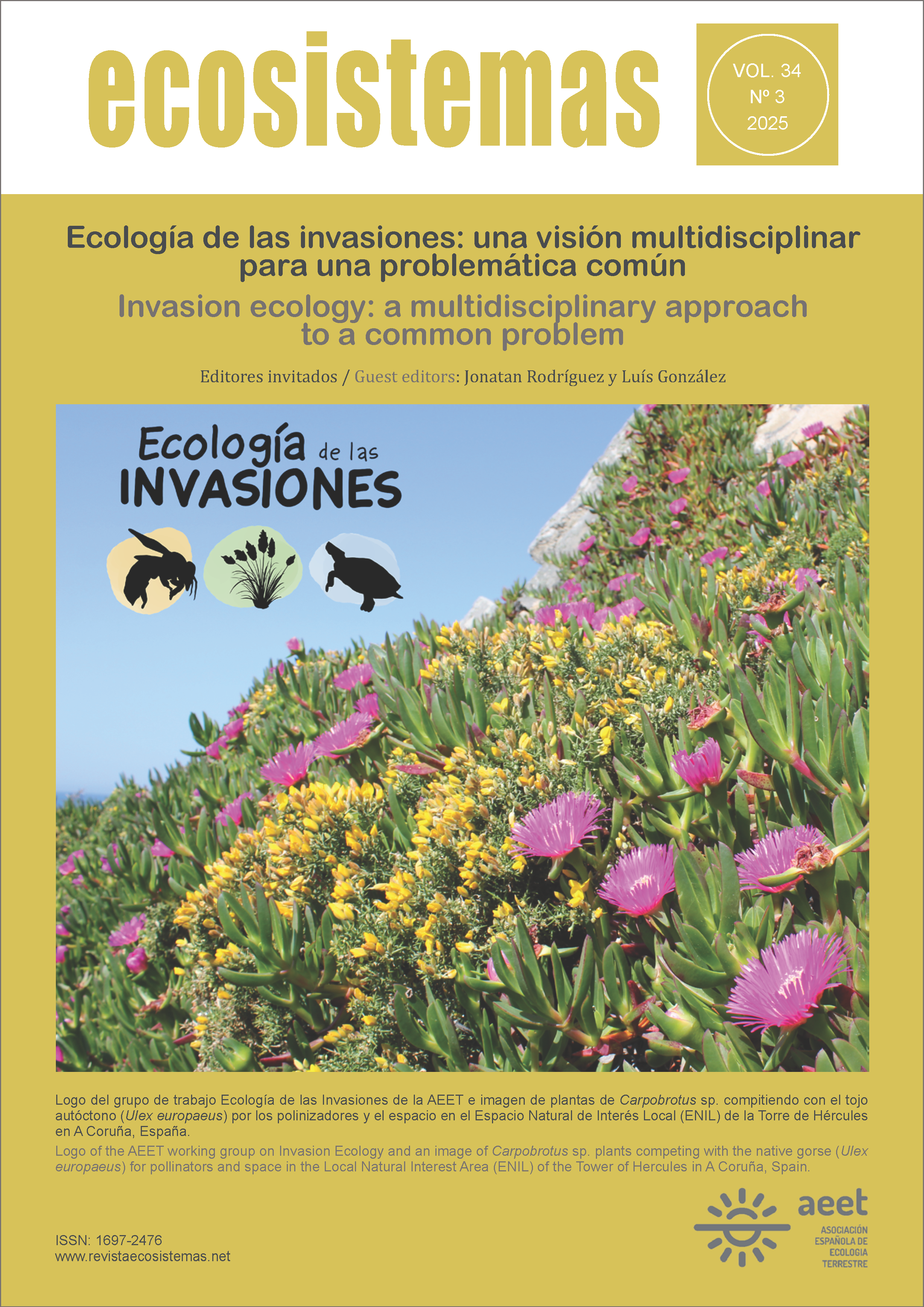
Main Article Content
Abstract
Biological invasions are an important element of global change and the second most important threat to the planet's biodiversity, representing an international problem that ignores political boundaries. Despite representing between 10 and 40 % of invasive organisms worldwide, seaweed still pose significant challenges. These are related species introduction, invasion mechanisms and its impacts, and therefore, the human responses (management) to these invasions. The success of an invasive species is defined by its ability to overcome all stages of the invasive process, overcoming all existing ecological barriers. This success can be aided by favourable environmental conditions, intrinsic factors of the invasive species (invasiveness), and the vulnerability of the host habitat (invasibility). Prevention remains the most effective and cost-effective defence against biological invasions, and prediction based on biological models is currently proposed as a useful tool. This paper reviews invasive marine macroalgae in the Alboran Sea, providing updated information on their biological and ecological characteristics, the expansion of each species, associated impacts, and invasion management strategies.
Downloads
Article Details

This work is licensed under a Creative Commons Attribution-NonCommercial 4.0 International License.
Accepted 2025-10-17
Published 2025-12-04