ecosistemas
ISSN 1697-2473
Open access / CC BY-NC 4.0
© 2026 The authors [ECOSISTEMAS is not responsible for the misuse of copyrighted material] / © 2026 Los autores [ECOSISTEMAS no se hace responsable del uso indebido de material sujeto a derecho de autor]
Ecosistemas 35(3): 3352 [September - December / septiembre - diciembre, 2026]: https://doi.org/10.7818/ECOS.3352
Associate editor / Editor asociado: Ignasi Bartomeus
NOTE / NOTA
Book review: “The Art of Making (Critical) Questions:
Resilient Thinking and Scientific
Craftsmanship” by
Raúl Ochoa-Hueso, 2026
Fernando T. Maestre1,* 
(1)
Environmental Science and Engineering, Biological and Environmental
Science and Engineering Division, King Abdullah University of Science and
Technology, Thuwal, Kingdom of Saudi Arabia.
* Corresponding author / Autor para
correspondencia: F. T. Maestre [fernando.maestregil@kaust.edu.sa]
|
> Received / Recibido: 15/09/2026
|
How to cite / Cómo citar: Maestre, F. T. (2026). Book
review: “The Art of Making (Critical) Questions: Resilient Thinking and
Scientific Craftsmanship” by Raúl Ochoa-Hueso, 2026. https://doi.org/10.7818/ECOS.3352
OCHOA-HUESO,
R. (2026). The Art of Making (Critical) Questions: Resilient Thinking and
Scientific Craftsmanship. A Survival Kit for PhD Students, Postdocs, and
Early-Career Researchers. [Kindle vs.] ASIN: B0HB4XF5V1. 115 pp.
Becoming a scientist involves much more
than learning how to design experiments, collect data, and analyze them. It
requires developing a way of observing, thinking, reading, writing, and
relating to others and, no less importantly, learning how to navigate an
academic world that is increasingly competitive, demanding, and uncertain. This
book addresses many of these dimensions from a highly personal perspective,
combining reflections on the scientific craft with numerous practical
recommendations aimed especially at those taking their first steps in research.
One of the book’s main strengths is
precisely its breadth. Across its pages, it discusses many of the ingredients
that contribute to building a successful and rewarding scientific career:
observation, asking questions, reading, writing, and taking care of our health
and relationships. The result is an engaging, well-written book packed with
useful advice. While more experienced researchers will recognize and already be
familiar with many of the ideas discussed in the book, I believe it will be
particularly valuable for early-career researchers.
I particularly liked the section devoted to
scientific writing. Writing well is one of the fundamental skills of our
profession and, paradoxically, one for which most scientists receive little
explicit training. The author provides concrete advice that can be genuinely
helpful both to those facing their first scientific papers and to more
experienced writers. This practical dimension is, in my view, one of the great strengths
of the book.
I also strongly agree with the importance
the author places on careful observation and extensive reading. At a time when
hyperconnectivity and pressure to produce can push us rapidly from one task to
the next, or lead us to rely excessively on large language models, preserving
the time needed to observe, think, and read is particularly timely. I
recognized myself in many of the reflections in the book related to these
practices. I am less convinced, however, by the special importance given to
reading the classics. Reading good literature can enrich our language, broaden
our perspective, and help us think better, but these benefits can be found in
many forms of literature, classical or contemporary. What matters most, in my
view and according to my own experience, is to read widely, with curiosity and
attention, and, of course, to enjoy what we read so that we keep reading.
Another aspect I especially welcomed is the
attention devoted to wellbeing. Taking care of ourselves, caring for those who
work with us, and maintaining a healthy balance between science and the rest of
our lives are not peripheral concerns. They are essential for sustaining
rewarding scientific careers in the long term. In this respect, I found the
book’s overall message both important and timely. However, I found this part of
the book unnecessarily long, and some of the more specific recommendations on
diet and lifestyle felt somewhat too prescriptive to me. What works for one
person will not necessarily work for another, and it is important to
distinguish between broadly applicable principles and personal choices that may
be perfectly valid but are not necessarily generalizable.
My main reservation concerns the
expectations created by the book’s title. Critical thinking is arguably one of
the most important abilities a scientist needs to develop, and I would have
welcomed a deeper and, above all, more practical discussion of how to cultivate
it. How do we learn to question our own assumptions? How do we recognize our
biases? How do we distinguish a convincing explanation from one that is merely
appealing? How do we teach our students to question prevailing ideas
respectfully? The excellent practical treatment of scientific writing shows
that the author could have offered a great deal in this area as well.
Finally, the book includes autobiographical
elements to illustrate some of its recommendations. These stories help explain
where the author’s ideas come from, but they also raise an issue that I
consider essential whenever we use our own trajectories to advise younger
researchers. Scientific careers do not depend only on talent, hard work, or
making good decisions. We are also products of our time, of the places where we
are born, of our family circumstances, of our gender, and of opportunities that
often arise by chance. Working today in a highly international environment,
surrounded by colleagues from very different countries and backgrounds, has
made me particularly aware of this. Looking back at my own career, it is
impossible to separate my decisions and effort from the enormous luck of having
been born in a country and into a family that provided me with education,
stability, and the resources needed to pursue first a university degree and
later a scientific career. Many equally talented and hardworking people simply
never receive comparable opportunities because they were born in a different
place or into a different family context. I therefore missed a more explicit
reflection in the book on the role of luck, privilege, and structural
inequalities. Acknowledging them does not diminish the achievements of those
who build successful careers. It simply helps us interpret those careers with
greater perspective and humility.
These
reservations do not alter my overall positive assessment of this book. Raúl
Ochoa-Hueso has written an accessible, thoughtful, and useful book about the
craft of doing science. Not every recommendation will work for everyone, nor
should it. Perhaps that is also one of the lessons that can be taken from the
book: there is no single way to become a successful scientist. But observing
carefully, reading widely, writing often, questioning our ideas, and taking
care of ourselves and of those around us are undoubtedly an excellent starting
point.
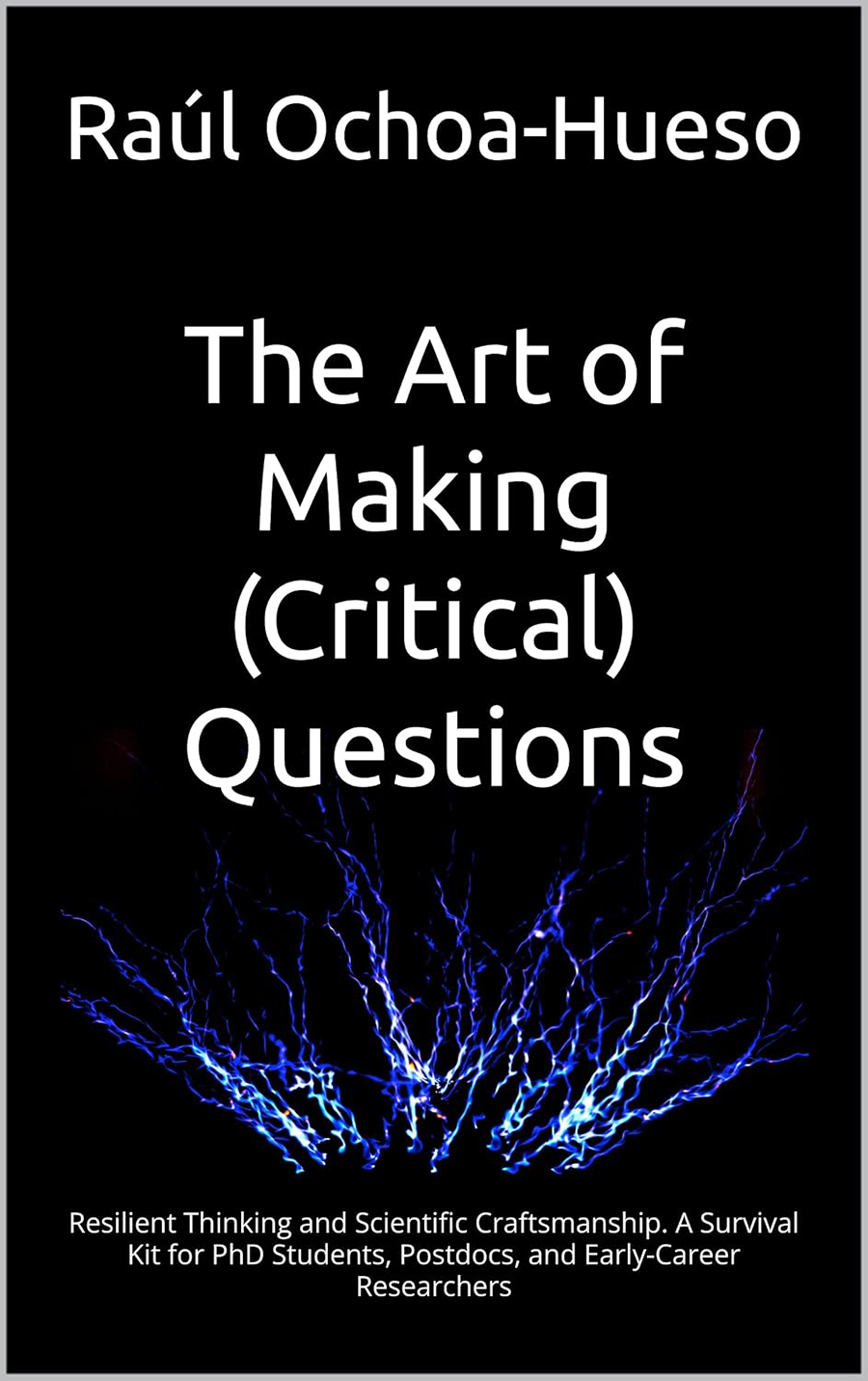
Figure
1. Cover of the book «The Art of Making (Critical)
Questions: Resilient Thinking and Scientific Craftsmanship. A Survival Kit for
PhD Students, Postdocs, and Early-Career Researchers».
Figura 1. Portada del libro «El arte de formular preguntas (críticas):
pensamiento resiliente y destreza científica. Un kit de supervivencia para
doctorandos, posdoctorados e investigadores en los inicios de su carrera».