ecosistemas
ISSN 1697-2473
Open access / CC BY-NC 4.0
© 2026 The authors [ECOSISTEMAS is not responsible for the misuse of copyrighted material] / © 2026 Los autores [ECOSISTEMAS no se hace responsable del uso indebido de material sujeto a derecho de autor]
Ecosistemas 35(3): 3254 [September - December / septiembre - diciembre, 2026]: https://doi.org/10.7818/ECOS.3254
Associate editor / Editora asociada: Laura Hernández-Mateo
DATA PAPER / ARTÍCULO DE DATOS
Urban refuges for Biodiversity: arthropod assemblages in the Botanical Garden of Medellín (Colombia)
José Soto Villalobos1,*
, María Isabel Ramírez Duque1 ![]()
(1) Fundación Jardín Botánico Joaquín Antonio Uribe de Medellín, Cl. 73 #51D-14, Medellín, Antioquia, Colombia.
* Corresponding author / Autor para correspondencia: José Soto [jose.soto@jbotanico.org]
|
> Received / Recibido: 14/04/2026 – Accepted / Aceptado: 28/09/2026 |
How to cite / Cómo citar: Soto Villalobos, J. A., & Ramirez Duque, M. I. (2026). Urban refuges for Biodiversity: arthropod assemblages in the Botanical Garden of Medellín (Colombia). Ecosistemas 35(3): 3254. https://doi.org/10.7818/ECOS.3254
|
Urban refuges for Biodiversity: arthropod assemblages in the Botanical Garden of Medellín (Colombia) Abstract: Despite their ecological importance, arthropods remain underrepresented in biodiversity datasets, especially in urban environments of tropical regions. Here, a dataset of arthropods recorded in the Botanical Garden of Medellín (Colombia) is presented, with the aim of contributing to the knowledge of urban biodiversity. The data were generated through a systematic biweekly monitoring scheme conducted at five representative sites between March 2021 and September 2024. A total of 134 arthropod morphospecies were recorded, including 15 arachnids (order Araneae) and 119 insects, with Lepidoptera being the most diverse group, represented by three records of moths and 58 of diurnal butterflies. Taxonomic identification began with the differentiation and classification of organisms into morphospecies and, whenever possible, proceeded to the genus or species level, with support from bibliographic sources, digital platforms such as the iNaturalist application, and consultations with experts. The information was standardized and published through SiB Colombia and GBIF and is presented in interoperable formats (Darwin Core), This facilitates their integration and retrieval through global biodiversity information platforms and networks. Quality control procedures included photographic verification, taxonomic validation through multiple sources, and consistency checks of metadata. This resource provides a baseline to assess arthropod diversity in urban green spaces, allowing the identification of patterns of species richness and composition, as well as potential sampling gaps. Additionally, it facilitates long-term monitoring of these groups in urban contexts and supports the development of future ecological, taxonomic, and conservation studies in Neotropical cities, contributing to a better understanding of the role of these organisms in highly transformed ecosystems. Keywords: arthropoda; GBIF; insects; botanical gardens; lepidoptera; SiB Colombia Refugios urbanos para la Biodiversidad: ensamblaje de artrópodos en el Jardín Botánico de Medellín (Colombia) Resumen: A pesar de su importancia ecológica, los artrópodos siguen estando subrepresentados en los conjuntos de datos de biodiversidad, especialmente en entornos urbanos de regiones tropicales. Aquí se presenta un conjunto de datos de artrópodos registrados en el Jardín Botánico de Medellín (Colombia), con el fin de contribuir al conocimiento de la biodiversidad urbana. Los datos fueron generados mediante un esquema de monitoreo sistemático quincenal realizados en cinco sitios representativos entre marzo de 2021 y septiembre de 2024. Se registraron 134 morfoespecies de artrópodos, incluyendo 15 arácnidos (orden Araneae) y 119 insectos, siendo Lepidoptera el grupo más diverso, representado por tres registros de polillas y 58 de mariposas diurnas. La identificación taxonómica comenzó mediante la diferenciación y clasificación de los organismos en morfoespecies y, cuando fue posible, se avanzó en su identificación hasta el nivel de género o especie, con el apoyo de fuentes bibliográficas, plataformas digitales como la aplicación iNaturalist y consultas con expertos. La información fue estandarizada y publicada a través de SiB Colombia y GBIF, y se presenta en formatos interoperables (Darwin Core), lo que facilita su integración y consulta en plataformas y redes globales de información sobre biodiversidad. Los procedimientos de control de calidad incluyeron la verificación fotográfica, la validación taxonómica mediante múltiples fuentes y la revisión de consistencia de los metadatos. Este recurso proporciona una línea base para evaluar la diversidad de artrópodos en espacios verdes urbanos, permitiendo identificar patrones de riqueza y composición de especies, así como posibles vacíos de muestreo. Además, facilita el monitoreo a largo plazo de estos grupos en contextos urbanos y apoya el desarrollo de futuros estudios ecológicos, taxonómicos y de conservación en ciudades neotropicales, contribuyendo a una mejor comprensión del papel de estos organismos en ecosistemas altamente transformados. Palabras clave: artrópoda; GBIF; insectos; Jardín Botánico; lepidoptera; SiB Colombia |
Background and Extended Abstract
Arthropods (Arachnida, Crustacea, Insecta, and Myriapoda) comprise one of the most diverse and abundant groups in the animal kingdom, playing essential roles in ecosystem functioning, including pollination, nutrient cycling, and biological pest control (Arenas-Clavijo et al., 2022; Collantes et al., 2023). In Colombia, their diversity is particularly high; by 2011, approximately 25 000 terrestrial arthropod species had been recorded, although estimates suggested that this number could reach up to 60 000 due to the country’s megadiversity and limited taxonomic knowledge (Amat-García y Fernández, 2011). Despite this progress, arthropods remain underrepresented in biodiversity datasets, particularly in urban environments of tropical regions.
Understanding arthropod diversity in different contexts is essential for evaluating responses to environmental change, especially in urban systems subject to strong anthropogenic pressures (Abrego et al., 2024). Biological inventories provide fundamental information on species presence, community composition, and their relationship with habitat conditions and environmental quality (Montoya-Molina et al., 2015). Within this group, Lepidoptera (butterflies and moths) have been widely used as bioindicators due to their sensitivity to habitat transformation (Garwood et al., 2022; Solano Gálvez, 2024). Numerous studies have shown that urbanization and habitat fragmentation significantly affect arthropod richness and composition (Chatelain et al., 2023), highlighting the importance of generating accessible and standardized datasets that allow these patterns to be assessed.
Urban green spaces, such as botanical gardens, play a key role in mitigating the negative effects of urbanization by acting as biodiversity refuges that provide resources and habitat heterogeneity for multiple taxa (Montoya-Molina et al., 2015). The Botanical Garden of Medellín is a case that deserves particular attention because, although it is embedded within a highly urbanized matrix, it contains a mosaic of habitats that may support diverse arthropod communities (Jardín Botánico de Medellín, n.d). However, studies focused on arthropods in botanical gardens in Colombia remain scarce, limiting the understanding of the ecological role of these spaces as reservoirs of urban invertebrate diversity.
At the regional level, several initiatives have contributed to the documentation of urban arthropods, including the use of citizen science platforms such as iNaturalist (Suárez Herrera, 2023), as well as monitoring and conservation projects led by academic institutions (Olaya-Arenas et al., 2023). In addition, entomological collections, such as the Francisco Luis Gallego Entomological Museum, constitute valuable sources of information, however they still require review and updating processes to strengthen regional knowledge. Nevertheless, the available data remain fragmented and, in many cases, difficult to access, reinforcing the need for structured and publicly accessible datasets.
In this context, we present a curated dataset of arthropods recorded at the Botanical Garden of Medellín, generated through systematic sampling conducted at five sites within the Botanical Garden, with contrasting sites characteristics, between March 2021 and September 2024. Due to the taxonomic complexity of the group and the limited availability of specialists, for the purposes of this study, specimens were classified into morphospecies, among which some taxa were identified to the species level, while others were identified to the genus, family, or tribe level.
The dataset comprises 134 arthropod morphospecies, of which 15 correspond to arachnids and 119 to insects. Lepidoptera was the order with the highest number of morphospecies, with 61 (58 diurnal butterflies and three moths). Within this order, Nymphalidae was the family with the highest richness, with 24 morphospecies, followed by Hesperiidae (14) and Pieridae (eight). The arachnids corresponded exclusively to the order Araneae, with records from seven families. Additionally, other insect groups, such as Hymenoptera, particularly Formicidae and Apidae, and Coleoptera, including Scarabaeidae and Coccinellidae, were recorded at multiple sampling sites.
In terms of taxonomic resolution, 79 morphospecies were identified to the species level, 38 to the genus level, 16 to the family level, and one to the tribe level. This distribution reflects both the scope of the identification process and the limitations associated with the availability of taxonomic resources and specialists. Despite these limitations, the dataset provides a baseline of the arthropods recorded within the study area.
Spatially, the records were distributed across five sites within the Botanical Garden with contrasting sitest characteristics. The “Butterfly House” had the highest richness, with 83 morphospecies, followed by the “Andean Forest,” with 39, and the “Urban Agriculture Laboratory,” with 30. The lowest richness was recorded at the “Francisco José de Caldas Lagoon,” with 13 morphospecies, and at the “Tree Pasture” site, with six, the latter being the site with the lowest richness of identified species (Table 1). The “Francisco José de Caldas Lagoon” was the only site where representatives of the order Odonata were recorded. These differences could be associated with the structural characteristics and environmental conditions specific to each site.
Table 1. Number of orders and taxa of arthropods recorded by sampling site.
Tabla 1. Número de órdenes y taxones de artrópodos registrados por sitio de muestreo.
|
Station |
Number of Orders |
Number of Taxas |
|
Butterfly House Station |
7 |
83 |
|
Andean Forest |
10 |
39 |
|
Urban Agriculture Laboratory |
5 |
30 |
|
Francisco José de Caldas Lagoon |
6 |
13 |
|
Tree Pasture |
3 |
6 |
The dataset also shows differences in the distribution of taxonomic groups among the sites. Lepidoptera, particularly Nymphalidae, were present at all five sites evaluated, whereas Hymenoptera and Coleoptera were recorded at four of the five sites. Predatory groups, such as spiders, were present at sites such as the “Butterfly House” and the “Andean Forest,” which could be related to the availability of prey and suitable sites for their establishment. Overall, the recorded taxonomic composition includes groups with different functional roles, including pollinators, detritivores, and predators, which could reflect the coexistence of multiple ecological functions within this urban green space.
Despite its strengths, the dataset has some limitations that should be considered, including: 1) the use of morphospecies, which may lead to an underestimation or overestimation of species richness; 2) the restriction of sampling to daytime periods, which could result in underrepresentation of nocturnal taxa; and 3) environmental conditions during the sampling periods, which may have influenced arthropod detection. For example, precipitation occurred during some sampling sessions and may have reduced the activity and detectability of certain groups, whereas environmental conditions were more favorable for their observation and recording during other sessions. These variations should be considered when interpreting the observed patterns.
This dataset provides a baseline for the study of arthropod richness in urban green spaces and allows the identification of patterns in species richness, taxonomic composition, and spatial variation. It also contributes to reducing current knowledge gaps regarding urban biodiversity in tropical regions and supports future ecological, taxonomic, and conservation research. By making these data available through interoperable platforms, this work promotes their reuse, facilitates their integration with global biodiversity information networks, and strengthens open science initiatives in the Neotropics.
Material and methods
Study area
This dataset compile records from the Botanical Garden of Medellín (Antioquia, Colombia). The Garden covers approximately 13.2 hectares and comprises a heterogeneous mosaic of sites, including forested areas, open vegetation, aquatic environments, and managed green spaces, which provide suitable conditions for a wide diversity of arthropods. Altitude. 1 486 masl. Coordinates. 6.270833° Latitude; -75.564167° Longitude.
Sampling design
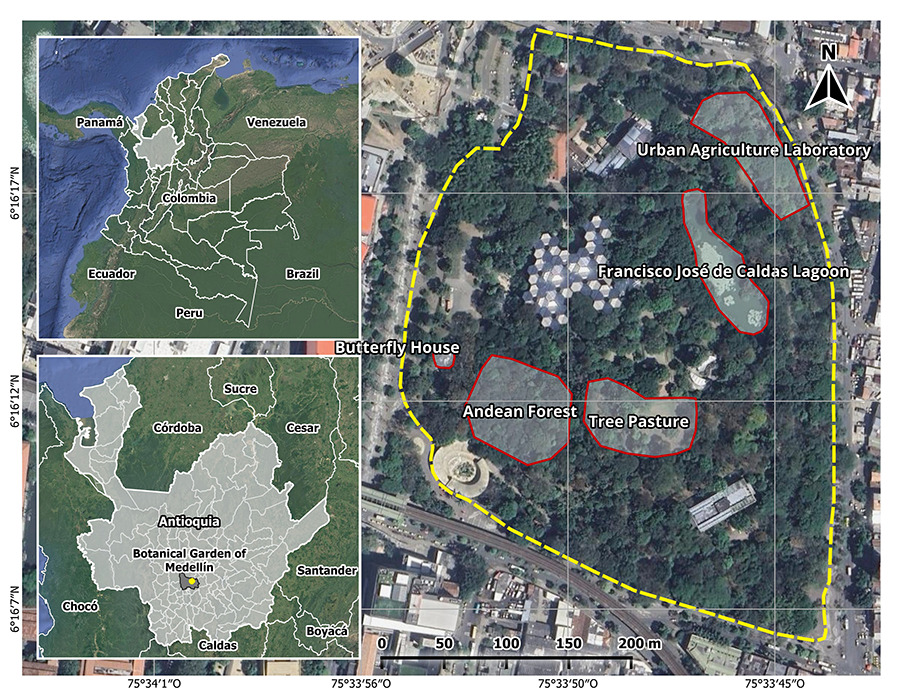
Five sampling sites were selected to represent the main site types within the Garden: (1) Andean Forest, (2) Butterfly house (free-flight area), (3) Urban agriculture laboratory, (4) Francisco José de Caldas Lagoon, and (5) Tree Pasture (Fig. 1).
Figure 1. Sampling stations selected in the study area.
Figura 1. Estaciones de muestreo seleccionadas en el área de estudio.
Sites selection was based on: (i) prior characterization within the Garden’s management plans, (ii) previous records of arthropods, and (iii) the presence of biotic and abiotic conditions (e.g., vegetation structure, humidity, temperature) favorable to arthropod occurrence.
Sampling was conducted between March 2021 and September 2024 using a biweekly monitoring scheme. Each sampling cycle was carried out over three consecutive days, covering the five sites with a standardized effort of approximately two hours per site. In total, 79 sampling cycles were completed, corresponding to 237 field days. Sampling was suspended during seven cycles due to adverse weather conditions.
Fieldwork was conducted between 10:00 and 12:00 h, using a standardized daytime sampling period defined based on accessibility, safety conditions within the surrounding urban environment, logistical constraints, and favorable weather conditions. Accordingly, sampling focused on arthropods recorded during this daytime period; therefore, taxa with predominantly nocturnal activity were not considered within the scope of this study. This condition should be considered when interpreting the records obtained and the documented taxonomic composition.
Sampling methods
Arthropods were recorded using a combination of active and passive sampling methods. Active sampling consisted of manual collection using entomological nets under a simple random sampling approach at each station, for which we hold a collection permit granted under ANLA Resolution No. 01711 of December 30, 2016. Passive sampling was conducted using Van Someren-Rydon traps without chemical attractants, primarily targeting Lepidoptera. At each station, five traps were installed, spaced approximately 20 m apart and suspended from tree branches at heights between 1 and 3 m (Villareal et al., 2004). Traps were baited with decomposing fish heads and monitored twice daily over a 48-hour period. In addition, direct observations and photographic records were used to document common species without collection. Only individuals that could not be reliably identified in the field were collected. Sampling followed responsible collection practices, minimizing disturbance to natural populations. No chemical attractants or substances harmful to non-target fauna were used.
Among the collected specimens were several Meliponini individuals, which were preserved in 70% ethanol as part of a previous study conducted at the Botanical Garden of Medellín and subsequently deposited in the biological collection of Universidad CES (CBUCES; García Orjuela & Soto, 2026).
Taxonomic identification
The records obtained were initially grouped into morphospecies based on their external morphological characteristics, including coloration patterns, size, and general morphology. Taxonomic identification was subsequently conducted for each morphospecies to the highest level of resolution attainable through consultation with specialists, literature review, and the use of digital resources such as Butterflies of America and iNaturalist. Because not all records could be identified to the species level, the results are presented at the morphospecies level for the purposes of this study, while identifications available at more specific taxonomic levels are provided in the Darwin Core file associated with the dataset. For example, Meliponini specimens were identified to the genus level. In cases of uncertain identification, photographic records were taken for verification by specialists. iNaturalist was used as a complementary resource for difficult-to-identify taxa, and only records that reached the Research Grade category on the platform were considered. In total, 18 morphospecies were identified using this resource.
Data recording and standardization
Most records were obtained through in situ observations and photographic documentation, reducing the need for specimen collection. A subset of specimens requiring detailed verification was collected and deposited in the Biological Collections Museum of Universidad CES (CBUCES). All records were organized in a Microsoft Excel spreadsheet, which included taxonomic information (class, order, family, genus, species, and subspecies), as well as metadata associated with each record, such as sampling site. Subsequently, the dataset was standardized according to biodiversity data standards and structured following the Darwin Core standard to facilitate its integration and interoperability with biodiversity information repositories. Finally, the information was published on biodiversity data platforms, including GBIF and SiB Colombia, making it available for consultation and use by global biodiversity information networks. Data cleaning included verification of taxonomic consistency, removal of duplicate records, and validation of the associated metadata.
Records and Data Availability and their Us
The dataset is publicly available through the Global Biodiversity Information Facility and SiB Colombia under open-access conditions and archived in stable repositories to ensure long-term accessibility.
Arthropod occurrence dataset (SM1)
• Data package title: Arthropod assemblages in the Botanical Garden of Medellín (Colombia) (Soto y Ramirez, 2026)
• Resource link: https://www.gbif.org/dataset/284d7d75-5478-4eb3-832f-aaf0e981eebc
• DOI: https://doi.org/10.15472/amxqby
• Format: Darwin Core Archive (DwC-A) and CSV
• Language: English
• License: Creative Commons (according to repository specifications)
• Coverage: Local (Botanical Garden of Medellín, Antioquia, Colombia)
• Temporal coverage: March 2021 – September 2024
• Spatial coverage: 6°16′15″N, 75°33′51″W; 1 486 m a.s.l.
• Taxonomic coverage: 134 arthropod morphospecies, including Arachnida (Araneae) and Insecta (e.g., Lepidoptera, Hymenoptera, Coleoptera)
• Data description: The dataset includes occurrence records with associated metadata such as taxonomic classification, geographic coordinates, sampling date, sampling protocol, and basis of record (observation or specimen).
Stingless bee occurrence dataset (SM2)
• Data package title: Identification of stingless bees present in artificial hives at the Botanical Garden of Medellín (Colombia)
• Resource link: https://www.gbif.org/dataset/9f0e8883-fbf1-47be-a854-b8ce20ea88b6
• DOI: https://doi.org/10.15472/bwd01l
• Format: Darwin Core Archive (DwC-A)
• Language: Spanish
• License: Creative Commons Attribution-NonCommercial 4.0 (CC BY-NC 4.0)
• Coverage: Local (Botanical Garden of Medellín, Antioquia, Colombia)
• Temporal coverage: February 22 – April 26, 2021
• Spatial coverage: 6.271° N, 75.564° W; 1,486 m a.s.l.
• Taxonomic coverage: 215 records of stingless bees (tribe Meliponini), representing five species identified to genus level, including Tetragonisca, Nannotrigona, Cephalotrigona, and Plebeia (two morphospecies/species-level records within the genus).
• Data description: The dataset includes biological occurrence records of stingless bees associated with artificial hives in the Botanical Garden of Medellín. Records include taxonomic information, sampling dates, geographic information, and observations associated with individual artificial hives. The study involved direct observations to document hive occupancy and the collection of 1–2 individuals per hive using an entomological aspirator. A total of 215 specimens were collected and preserved in 70% ethanol for taxonomic identification.
Technical Validation
The dataset underwent a validation process to ensure the quality of the information and its suitability for reuse. Taxonomic identification was based on morphospecies classification, supported by photographic records, bibliographic references (DeVries, 1987; LeCrom et al., 2004; Jaramillo, 2018), the use of digital platforms and resources such as iNaturalist and Butterflies of America, and, when available, consultation with specialists. Given the use of morphospecies, validation focused on maintaining consistency in morphological criteria across all records rather than achieving complete species-level resolution. Individuals were grouped based on observable characteristics, such as coloration patterns, size, and general morphology, and records with uncertainty were conservatively assigned to higher taxonomic levels (genus or family) to avoid misidentifications.
Spatial validation was conducted by verifying that all records corresponded to the predefined sampling sites within the Botanical Garden of Medellín. Each observation was checked for consistency between the assigned site and the field records. Because sampling was restricted to a well-defined and relatively small area, spatial uncertainty is low at the site level, although fine-scale variation within each site is not captured. No records were identified outside the study area.
Temporal validation included cross-checking all dates against field records to ensure that the records corresponded to the established sampling period between March 2021 and September 2024. Records corresponding to periods during which sampling was suspended due to adverse weather conditions were excluded. Sampling effort was also documented throughout the study period, taking into account variations in the number of sampling cycles conducted between the dry and rainy seasons. During the rainy season, seven sampling cycles were suspended due to high precipitation, resulting in a greater number of sampling cycles being conducted during the dry season. These temporal differences in the number of sampling events were considered when interpreting the records obtained and the detectability of taxa.
Data consistency was ensured by organizing all records in a structured spreadsheet (Microsoft Excel) containing taxonomic information and associated metadata, such as location. Data cleaning included the review of duplicate records, standardization of taxonomic nomenclature, and verification of data completeness. Duplicate records were identified based on matching morphospecies, sampling site, and date, and were removed unless they represented independent observations.
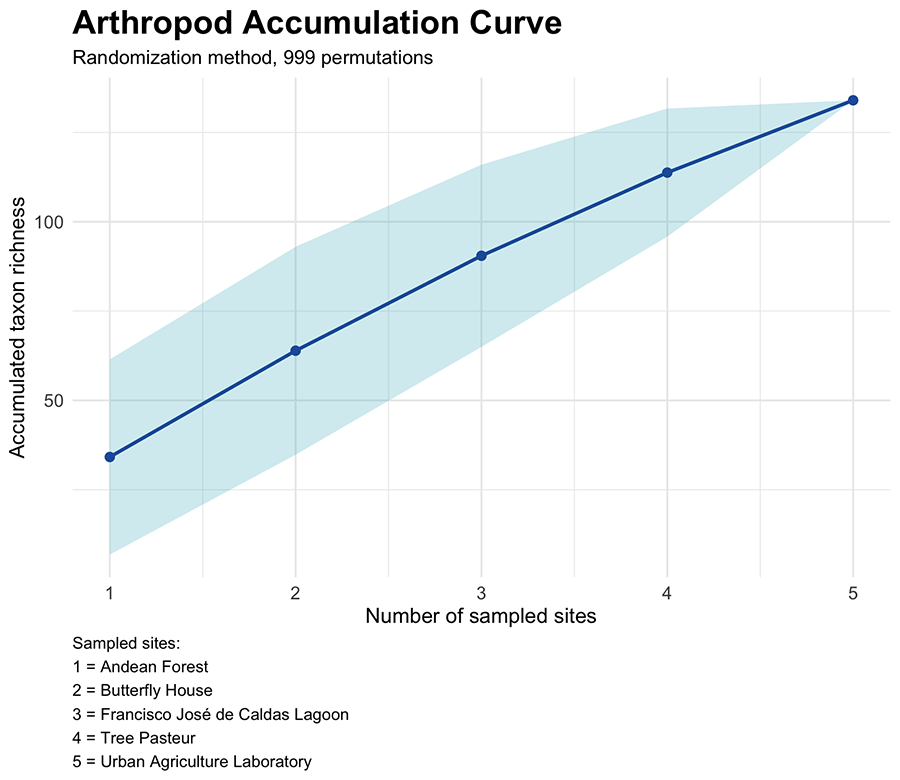
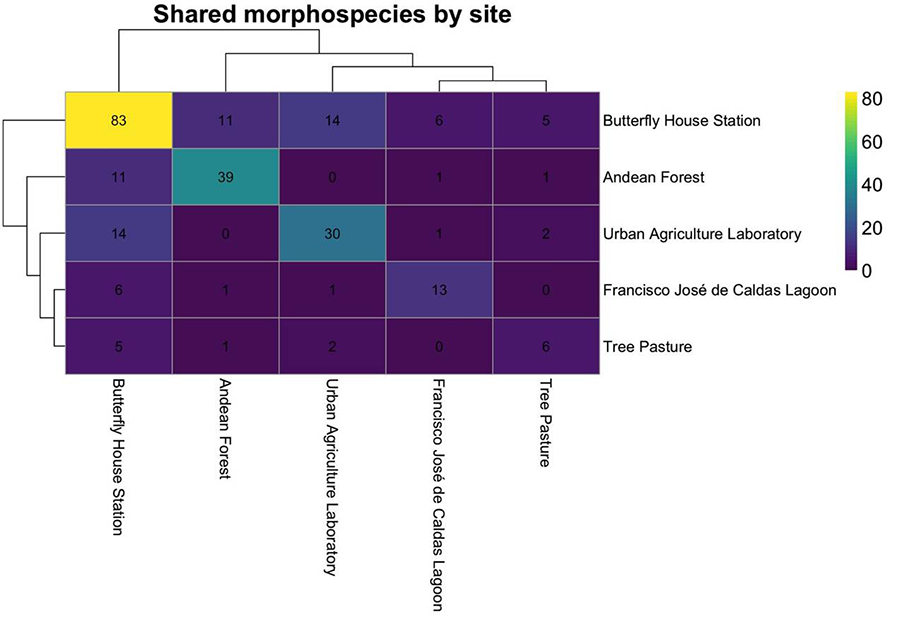
Additionally, the dataset was analyzed using R version 4.5.3 (R Core Team, 2026) to assess sampling representativeness and the consistency of records among sites, using a taxon accumulation curve (Fig. 2) and an analysis of the number of morphospecies shared among sites (Fig. 3). The analyses were conducted using the readxl (version 1.6.0; Wickham & Bryan, 2026), dplyr (version 1.2.1; Wickham et al., 2026a), tidyr (version 1.3.2; Wickham et al., 2026b), vegan (version 2.6-10; Oksanen et al., 2025), ggplot2 (version 4.0.2; Wickham, 2016), pheatmap (version 1.0.13; Kolde, 2025), and viridis (version 0.6.5; Garnier et al., 2024) packages.
Taxon accumulation increased progressively with the inclusion of sampling sites (Fig. 2), from approximately 34 taxa when a single site was considered to 134 taxa when all five sampling sites were included. Because the accumulation curve was generated by randomizing the order of the five sampling sites, the points along the curve represent the cumulative richness obtained as an increasing number of sites was considered, regardless of the order in which they were sampled. The rate of accumulation progressively decreased as additional sites were incorporated, such that each successive site contributed a smaller increment to cumulative richness. However, the curve did not reach a clear asymptote across the five sites considered, and richness continued to increase with the inclusion of the fifth site. Overall, this pattern indicates that the inclusion of the different sampling sites contributed cumulatively to the recorded arthropod richness within the Medellín Botanical Garden.
Figure 2. Arthropod taxon accumulation curve across the sampled sites. The curve represents the cumulative taxonomic richness as the number of sampled sites increases. The blue line shows the mean cumulative taxonomic richness obtained from 999 random permutations of the sites order, while the shaded area represents the standard deviation across permutations. The sites included were: 1) Andean Forest, 2) Butterfly House, 3) Francisco José de Caldas Lagoon, 4) Tree Pasture, and 5) Urban Agriculture Laboratory.
Figura 2. Curva de acumulación de taxones de artrópodos en los sitios muestreados. La curva representa la riqueza taxonómica acumulada a medida que aumenta el número de sitios muestreados. La línea azul muestra la riqueza taxonómica acumulada media obtenida mediante 999 permutaciones aleatorias del orden de los hábitats, mientras que el área sombreada representa la desviación estándar entre las permutaciones. Los sitios incluidos fueron: 1) Bosque Andino, 2) Casa de las Mariposas, 3) Laguna Francisco José de Caldas, 4) Potrero Arbolado y 5) Laboratorio de Agricultura Urbana.
Figure 3. Number of arthropod morphospecies shared among the sampled sites. The heatmap shows the number of morphospecies shared between pairs of sites, with values on the diagonal representing the total number of morphospecies recorded in each site. Darker colors indicate a greater number of shared morphospecies. The dendrograms represent the hierarchical clustering of site based on their morphospecies composition.
Figura 3. Número de morfoespecies de artrópodos compartidas entre los sitios muestreados. En este mapa de calor se representa el agrupamiento jerárquico de los sitios de acuerdo con su composición de morfoespecies. Se muestra el número de morfoespecies compartidas entre pares de sitios, mientras que los valores de la diagonal representan el número total de morfoespecies registradas en cada hábitat. Los colores más intensos indican un mayor número de morfoespecies compartidas.
The number of morphospecies shared between pairs of sites was generally low relative to the richness recorded at each site. For example, the Andean Forest and Urban Agriculture Laboratory did not share any morphospecies, while the Francisco José de Caldas Lagoon and the Tree-Grassland Area also had no morphospecies in common. The highest number of shared morphospecies was observed between the Butterfly House and the Urban Agriculture Laboratory (14), followed by the Butterfly House and the Andean Forest (11). These patterns indicate considerable variation in arthropod assemblages among sites and highlight the contribution of the different stations to overall observed richness.
Differences in richness and in the number of shared morphospecies among sites could be related to the particular characteristics of each environment, including vegetation structure, resource availability, and microenvironmental conditions, as well as differences in site management and use. The low overlap observed between some pairs of sites could therefore reflect arthropod assemblages associated with particular environmental conditions, whereas the greater number of shared morphospecies between the Butterfly House and other sites could be related to the presence of resources and conditions favorable to a broader range of taxa. Nevertheless, these patterns should be considered as hypotheses regarding the potential differences in arthropod assemblage composition among sites.
Author Contributions
José Alberto Soto: Conceptualization, Methodology, Investigation, Supervision, Writing – original draft, Writing – review & editing, Project administration. María Isabel Ramírez: Investigation, Data curation, Formal analysis, Visualization, Writing – original draft, Writing – review & editing.
Funding, Required Permits, Potential Conflicts of Interest, and Acknowledgments
This research was supported by the Jardín Botánico de Medellín.
The research was conducted under a collection permit granted by the Autoridad Nacional de Licencias Ambientales (ANLA), Resolution No. 01711 of December 30, 2016.
The authors declare that they have no conflicts of interest.
The authors are grateful to the Jardín Botánico de Medellín for providing the opportunity and support to conduct this research. We are also grateful to the experts and specialists who contributed to the identification of the morphospecies.
References
Abrego, L. J., Rivera, J. A., Garrido, A., & Wilkie, E. (2024). Literature review of the impact of fragmentation and urbanization on insect communities. Mesoamericana, 26(1), 33–40. https://doi.org/10.48204/j.mesoamericana.v26n1.a5079
Amat-García, G., Fernández, F. (2011). La diversidad de insectos (Arthropoda: Hexapoda) en Colombia. I. Entognatha a Polyneoptera. Acta Biológica Colombiana 16(2): 205–219. https://revistas.unal.edu.co/index.php/actabiol/article/view/19277
Arenas-Clavijo, A., Montoya-Lerma, J., & Moret, P. (2022). Diversity of Geadephaga (Coleoptera: Carabidae and Cicindelidae) in Colombia: An approach from existing literature. Biota Colombiana, 22(2), e962. https://doi.org/10.21068/2539200X.962
Butterflies of America. (n.d.). Butterflies of America. [Consulted between March 2021 and September 2024]. https://www.butterfliesofamerica.com/
Chatelain, M., Rüdisser, J., & Traugott, M. (2023). Urban-driven decrease in arthropod richness and diversity associated with group-specific changes in arthropod abundance. Frontiers in Ecology and Evolution, 11, 980387. https://doi.org/10.3389/fevo.2023.980387
Collantes, R. D., Del Cid, R., Santos-Murgas, A., & Atencio, R. (2023). Importance of pollinating insects in the sustainability of productive agroecosystems. Revista Semilla del Este, 3(2), 8–26. https://revistas.up.ac.pa/index.php/semilla_este/article/view/3755
DeVries, P. J. (1987). The butterflies of Costa Rica and their natural history. Volume I: Papilionidae, Pieridae, Nymphalidae. Princeton University Press, Princeton, USA.
García Orjuela C.L, Soto, J. (2026). Identificación de abejas sin aguijón presentes en colmenas artificiales en la Fundación Jardín Botánico “Joaquín Antonio Uribe” de Medellín – Antioquia. Version 1.1. Fundación Jardín Botánico Joaquín Antonio Uribe de Medellín. Occurrence dataset. https://doi.org/10.15472/bwd01l
Garnier, S., Ross, N., Rudis, R., Camargo, A. P., Sciaini, M. & Scherer, C. (2024). viridis(Lite) – Colorblind-Friendly Color Maps for R. viridis package version 0.6.5. https://doi.org/10.5281/zenodo.4679423
Garwood, K., Huertas, B., Ríos-Málaver, I.C., Jaramillo, J.G. (2022). Mariposas de Colombia Lista de chequeo / Butterflies of Colombia Checklist (Lepidoptera: Papilionoidea). BioButterfly Database, 2.ª edición, 304 pp. https://www.butterflycatalogs.com/uploads/1/0/3/2/103240120/ colombia_butterfly_checklist_2nd_ed_30nov2022_.pdf
iNaturalist community. Observations of Abracris flavolineata, Anartia amathea, Atta cephalotes, Battus polydamas, Cupiennius coccineus, Danaus plexippus, Golofa porteri, Heliconius charithonia, Leptotes cassius, Xenophanes tryxus, Odontomachus chelifer, Eulepte, Chrysopini, Panchlora, Leptoglossus, Odontomachus erythrocephalus, Mischocyttarus, and Rhytidochrota brunneri from Jardín Botánico de Medellín, Colombia, observed between April 28, 2023 and September 21, 2024. Records available at https://www.inaturalist.org/ [Used on January, 2006].
Jaramillo, D. (2018). Butterflies of Medellín and its strategic ecosystems. Medellín Mayor's Office. https://www.medellin.gov.co/es/wp-content/uploads/2021/09/Mariposas-de-Medellin.pdf
Jardín Botánico de Medellín. (n.d.). Jardín Botánico Joaquín Antonio Uribe de Medellín. [Used on January, 2006]. https://www.botanicomedellin.org/
Kolde, R. (2025). pheatmap: Pretty Heatmaps. R package version 1.0.13. https://doi.org/10.32614/CRAN.package.pheatmap
LeCrom, J. F., Llorente, J. B., Constantino, L. M., & Salazar, J. A. (2004). Butterflies of Colombia: Volume II. Pieridae. Carlec Ltda, Bogotá, Colombia. ISBN: 958-33-3589-4
Montoya-Molina, S., Giraldo-Echeverri, C., Montoya-Lerma, J., Escobar, F., Chará, J., & Murgueitio, E. (2015). Diversidad de escarabajos coprófagos en sistemas silvopastoriles del Valle del río Cesar, Colombia. En: P. L. Peri (Comp.), 3° Congreso Nacional de Sistemas Silvopastoriles – VIII Congreso Internacional de Sistemas Agroforestales pp. 662–665. Ediciones INTA. https://www.researchgate.net/publication/282815814_Diversidad_de_escarabajos_coprofagos_en_sistemas_silvopastoriles_del_Valle_del_rio_Cesar_Colombia
Oksanen, J., Simpson, G. L., Blanchet, F. G., Kindt, R., Legendre, P., Minchin, P. R., … Weedon, J. (2025). vegan: Community Ecology Package. R package version 2.6-10. https://doi.org/10.32614/CRAN.package.vegan
Olaya-Arenas, P., Durán-Prieto, J., Pinzón Florián, O. P., & Becerra Guerrero, N. S. (2023). Insects of the urban trees of Bogotá (Colombia): Exploring their diversity and function. Botanical Garden of Bogotá. https://jbb.gov.co/nosotros/publicaciones/insectos-del-arbolado-urbano-de-bogota/
R Core Team. (2026). R: A Language and Environment for Statistical Computing. R Foundation for Statistical Computing, Vienna, Austria. d https://doi.org/10.32614/R.manuals
Solano Gálvez, L. N. (2024). Lepidoptera as indicators of the ecosystem in the Zapotal commune, province of Santa Elena [Undergraduate thesis, Santa Elena Peninsula State University]. https://repositorio.upse.edu.ec/handle/46000/11777
Soto, J., Ramírez, M. (2026). Refugios urbanos para la Biodiversidad: ensamblaje de artrópodos en el Jardín Botánico de Medellín (Colombia). Version 2.1. Fundación Jardín Botánico Joaquín Antonio Uribe de Medellín. [Checklist dataset]. https://doi.org/10.15472/amxqby
Suárez Herrera, J. G. (2023). Diversity of arthropods of Medellín through the observations of iNaturalist [Undergraduate thesis, CES University]. https://repository.ces.edu.co/handle/10946/6020
Villarreal, H., Álvarez, M., Córdoba, S., Escobar, F., Fagua, G., Gast, F., … Umaña, A. (2004). Manual of methods for the development of biodiversity inventories. Instituto de Investigación de Recursos Biológicos Alexander von Humboldt. https://sib.gob.ar/archivos/IAVH-00288.pdf
Wickham, H. (2016). ggplot2: Elegant Graphics for Data Analysis. Springer-Verlag, New York, USA. https://doi.org/10.1007/978-3-319-24277-4
Wickham, H. & Bryan, J. (2026). readxl: Read Excel Files. R package version 1.6.0. https://doi.org/10.32614/CRAN.package.readxl
Wickham, H., François, R., Henry, L., Müller, K. & Vaughan. (2026a). dplyr: A Grammar of Data Manipulation. R package version 1.2.1. https://doi.org/10.32614/CRAN.package.dplyr
Wickham, H., Vaughan, D. & Girlich, M. (2026b). tidyr: Tidy Messy Data. R package version 1.3.2. https://doi.org/10.32614/CRAN.package.tidyr