ecosistemas
ISSN 1697-2473
Open access / CC BY-NC 4.0
© 2026 The authors [ECOSISTEMAS is not responsible for the misuse of copyrighted material] / © 2026 Los autores [ECOSISTEMAS no se hace responsable del uso indebido de material sujeto a derecho de autor]
Ecosistemas 36(1): 3231 [January - April / enero - abril, 2027]: https://doi.org/10.7818/ECOS.3231
MONOGRAPHIC: Palaeoecology and global change / MONOGRÁFICO: Paleoecología y cambio global
Guest editors / Editores/as invitados/as: Graciela Gil-Romera, César Morales del Molino & Juan Manuel Rubiales Jiménez
REVIEW ARTICLE / ARTÍCULO DE REVISIÓN
Landscapes of deep time: botanical paleoart for depicting paleoecosystems
Gabriela Amorós1  , Salvador Conesa2 , Ariadna Amorós2, José Carrión1,*
(1) Departamento de Biología Vegetal, Facultad de Biología, Universidad de Murcia, Campus de Espinardo, Spain.
(2) Departamento de Bellas Artes, Facultad de Bellas Artes, Universidad de Murcia, Campus de Espinardo, Spain.
* Corresponding author / Autor para correspondencia: José Carrión [carrion@um.es]
|
> Received / Recibido: 13/03/2026 – Accepted / Aceptado: 21/07/2026 |
How to cite / Cómo citar: Amorós, G., Carrión García, J. S., Valdés Amorós, A., & Conesa Tejada, S. (2026).Landscapes of deep time: botanical paleoart for depicting paleoecosystems. Ecosistemas 36(1): 3231. https://doi.org/10.7818/ECOS.3231
|
Landscapes of deep time: botanical paleoart for depicting paleoecosystems Abstract: Visual reconstructions play a central role in paleoecology, where past ecosystems must be inferred from fragmentary and indirect evidence. Paleoart has long contributed to this task, yet it has traditionally been dominated by a zoocentric perspective in which vegetation functions as a secondary or decorative element. This article examines botanical paleoart as a distinct and necessary practice for depicting paleoecosystems, arguing that plants are not merely background components but primary ecological agents that structure landscapes, climates, and evolutionary trajectories through deep time. We provide a historical and methodological analysis of botanical paleoart, tracing its origins from nineteenth-century collaborations—most notably that between Franz Unger and Josef Kuwasseg—through twentieth-century syntheses such as Rudolph Zallinger’s murals, to contemporary practices grounded in paleoecology. Particular attention is given to the epistemic challenges posed by the plant fossil record, including fragmentary macrofossils, ambiguous palynomorphs, architectural uncertainty, and competing biological interpretations. Drawing on recent Quaternary case studies developed within the ECCE HOMO research group (University of Murcia), we illustrate how botanical paleoart can function as an explicit visual synthesis of palynological, macrofossil, and ecological data. These reconstructions demonstrate that paleoart is not merely illustrative but heuristic, capable of integrating evidence, highlighting uncertainty, and generating new paleoecological insights. Keywords: landscape painting; paleoart; paleobotany; paleoecology; scientific illustration Paisajes en el tiempo profundo: paleoarte botánico y representación de paleoecosistemas Resumen: Las reconstrucciones visuales desempeñan un papel central en paleoecología, donde los ecosistemas del pasado deben inferirse a partir de evidencias fragmentarias e indirectas. El paleoarte ha contribuido durante mucho tiempo a esta tarea; sin embargo, tradicionalmente ha venido siendo abordado desde una perspectiva zoocéntrica en la que la vegetación funciona como un elemento secundario o meramente decorativo. Este artículo examina el paleoarte botánico como una práctica diferenciada y necesaria para la representación de paleoecosistemas, recordando que las plantas no son simples componentes de fondo, sino agentes ecológicos primarios que estructuran paisajes, climas y trayectorias evolutivas a lo largo del tiempo profundo. Presentamos también un análisis histórico y metodológico del paleoarte botánico, rastreando sus orígenes desde las colaboraciones del siglo XIX —especialmente la establecida entre Franz Unger y Josef Kuwasseg— hasta las síntesis del siglo XX, como los murales de Rudolph Zallinger, y las prácticas contemporáneas fundamentadas en la paleoecología. Se presta especial atención a los desafíos epistémicos que plantea el registro fósil vegetal, incluyendo macrofósiles fragmentarios, palinomorfos ambiguos, incertidumbres taxonómicas y la existencia de interpretaciones biológicas divergentes. A partir de estudios del Cuaternario desarrollados en el grupo de investigación ECCE HOMO (Universidad de Murcia), mostramos cómo el paleoarte botánico puede operar como una síntesis visual explícita de datos paleoecológicos. Estas reconstrucciones demuestran que el paleoarte no es meramente ilustrativo, sino también heurístico, capaz de integrar evidencias, poner de relieve las incertidumbres y generar nuevos conocimientos paleoambientales. Palabras clave: ilustración científica; paisaje; paleoarte; paleobotánica; paleoecología |
Introduction
Visual communication affords a unique capacity for the comprehension and retention of complex concepts, as it relies on neurocognitive mechanisms closely linked to attention, memory, and learning. From the perspective of cognitive psychology, it has been demonstrated that visual and verbal information are processed through partially independent yet complementary systems, such that their combination fosters the construction of more robust and durable mental representations (Paivio, 1986). Along the same lines, multimedia learning models indicate that the coherent integration of images and text reduces cognitive load and enhances deep understanding, particularly in methodologically and conceptually complex domains (Mayer, 2024). From a neurobiological standpoint, studies on visual perception and consciousness show that images activate neural networks that facilitate conscious access to information, increasing sustained attention and the capacity for conceptual inference (Dehaene, 2014).
The intuition underlying this phenomenology has long been articulated within literary and artistic traditions, which have argued that images do not function merely as complements to verbal language, but rather as cognitive devices capable of condensing and transmitting complex structures of meaning. In the words of William Blake, one may “see a world in a grain of sand,” a poetic formulation that anticipates the synthetic power of images as a form of knowledge.
It is within this context that paleoart acquires a particular relevance, as the paleosciences are especially sensitive to this form of neurocognitive engagement due to their need to reconstruct scenarios inaccessible to direct visual experience. Here, the term paleoart is used to denote an interdisciplinary practice situated at the intersection of art and paleontology, whose aim is the visual rehabilitation of extinct organisms within their chronological, ecosystemic, and landscape frameworks. In this sense, paleoart productively confronts the traditional dichotomy between the “two cultures” (Snow, 1961), operating as a form of convergence that may be situated within the horizon of a “third culture” (Brockman, 1995).
In practice, paleoart takes shape through a wide range of communicative formats—including two- and three-dimensional works, scientific illustrations, animations, sculptures, and digital models—aimed at producing images that are simultaneously scientifically plausible and effective from an aesthetic and communicative perspective (Hallett, 1986; Lescaze et al., 2017). Given the impossibility of direct observation of the past, paleoartists necessarily work through visual styles capable of encoding and transmitting scientific information. As Ernst H. Gombrich famously argued in Art and Illusion (Gombrich, 2023), “all art operates by means of symbols and conventional or conceptual schemata.” Style therefore becomes a critical variable, differing in its capacity to structure, encode, and convey information. This dual requirement—scientific rigor and visual efficacy—inevitably entails a sustained dialogue between scientists and artists, in which visual production is not a secondary or illustrative outcome but a shared interpretative process (Amorós, 2023, 2024).
Such dialogue may also be articulated through scientific illustration, whose primary objective is to represent observable structures in support of research and teaching. Paleoart, however, necessarily involves a further step beyond what is strictly documentable: it constitutes a form of reconstruction that integrates fossil data, well-grounded inference, and ecological context in order to restore extinct organisms and ecosystems in their functional and spatial complexity (Rudwick, 1992; Amorós et al., 2025; Carrión et al., 2026a). Historically, this distinction can be traced back to naturalists who illustrated their own materials and became consolidated with the progressive collaboration between scientists and artists, in parallel with the expansion of paleontological literature.
The initial definition of paleoart proposed by Hallett (1986) contains a marked zoocentric component that becomes limiting when a fully paleoecosystemic approach is sought. Nevertheless, this bias is understandable given the long-standing predominance, in both scientific communication and the collective imagination, of representations centered on animal behavior and gestural dynamism (Witton et al., 2014). Plants pose specific challenges for paleoartistic visualization: many of the key aspects of their biology are slow, invisible, or conceptual in nature, and are deeply intertwined with the geological context (Bressan, 2012; Sanisidro and Barrón, 2016).
This difficulty has reinforced an anthropocentric bias whereby animals occupy the center of the narrative dispositive, while vegetation is relegated to a scarcely informative backdrop. In this sense, zoocentrism in paleoart may be interpreted as one manifestation of what has been termed plant blindness, namely the systematic tendency to ignore or undervalue the role of plants in natural systems (Balding and Williams, 2016). This imbalance is not merely aesthetic but also epistemological, as it leads to an incomplete and fragmented understanding of the past.
Overcoming this “plant blindness” requires recognizing plants as ecological protagonists, integrating multiple scales of analysis, and assuming that botanical complexity is not an obstacle but an opportunity to expand the conceptual scope of paleoart. This perspective is also inscribed within a long cultural tradition of landscape painting, understood as a projection of the human relationship with nature (Clark, 1971). Ultimately, although paleoart is often imprecisely subsumed within the broad cohort of scientific communication methods, it may be understood as a form of conceptual resistance against the modern dissociation between organisms and landscape: not as opposition to the convergence of art and science, but as a critique of the fragmentation of nature into isolated elements (Deleuze, 1985; Agamben, 2017).
Objectives and scope
Here we reflect on botanical paleoart from both a historical and a methodological perspective, aiming to convey not only its scientific and communicative potential but also the practical difficulties inherent to its practice, many of which stem from the incompleteness and bias of the plant fossil record. We provide a concise overview of the history of paleoart and botanical paleoart, culminating in recent work led by the ECCE HOMO research group at the University of Murcia. As a heuristic and illustrative exercise, we analyze two paradigmatic cases of botanical success in paleoartistic practice, a field traditionally skewed by science communication preferences toward vertebrate fauna—particularly dinosaurs and mammals. These case studies focus on works that engage respectfully and rigorously with botanical taxonomy: on the one hand, the nineteenth-century collaboration between Franz Unger and Josef Kuwasseg, and on the other, the mid-twentieth-century oeuvre of Rudolph Zallinger. We conclude by assessing current challenges and research perspectives in botanical paleoart, as well as its educational and aesthetic implications, arguing for its role in the broader democratization of scientific knowledge.
Historical remarks
Although the term paleoart is relatively recent, the impulse to give visual form to beings from the deep past long predates paleontology as a scientific discipline. Since Antiquity, fossils have exerted a significant influence on the mythical imagery of monsters and fabulous creatures, understood not as arbitrary fantasies but as cultural mediations in response to discoveries that were, at the time, incomprehensible (Romano and Avanzini, 2019; Mayor and Tapia, 2020; Romano, 2024). In Europe, this visual translation of the past took more concrete forms, such as the Lindwurm of Klagenfurt or the illustrations of Athanasius Kircher, in which legendary creatures coexisted with naturalistic observations (Rudwick, 2008). A singular milestone in this transition was Johann Jakob Scheuchzer’s Physica Sacra (1731–1735), whose illustrations integrated fossils, organisms, and landscapes within a biblical narrative, yet with an unusually high degree of naturalistic detail for its time (Rudwick, 1992). In these images, vegetation and topography played a structural role, anticipating a paleoartistic sensibility centered on the coexistence of plants, animals, and environment (Amorós, 2024; Carrión et al., 2026a).
At the beginning of the nineteenth century, the first explicit attempts at anatomical reconstruction based on fossils appeared, but the true turning point came with Henry De la Beche’s Duria Antiquior in 1830. This work inaugurated a narrative mode of paleoart by depicting multiple organisms interacting within a geologically coherent environment, breaking with the tradition of isolated plates characteristic of scientific illustration (Amorós, 2023). From that moment onward, reconstructions proliferated and were progressively incorporated into public space, culminating in iconic projects such as the Crystal Palace dinosaurs in London, which consolidated the popular imaginary of deep time and opened the way to the commercialization of paleoart (Jäger et al., 2018). The second half of the nineteenth century and the first third of the twentieth century constitute the classical phase of paleoart, marked by figures such as Charles R. Knight, Zdeněk Burian, and Rudolph Zallinger, whose works defined the iconography of prehistory for decades. From the 1970s onward, the so-called “Dinosaur Renaissance” radically transformed this paradigm by incorporating new evolutionary interpretations, giving rise to morphologically more informed representations (Milner, 2012).
In recent decades, paleoart has consolidated as a professional practice closely linked to scientific research, while digitalization and online dissemination have fostered a diverse and active global community (Ansón et al., 2015). Throughout this trajectory, paleoart emerges as a space of constant negotiation between data and imagination, between rigor and creativity. However, despite its increasing ecological sophistication, one component has remained systematically underrepresented: vegetation. It is precisely this absence—and its impact on the reconstruction of past ecosystems—that justifies a specific focus on botanical paleoart and its integration with paleoecology.
Botanical paleoart: origins and development
Botanical paleoart can be defined as a form of paleoart in which flora and vegetation structure—and not only fauna—are treated as the central objects of reconstruction, grounded in paleobotanical and paleoecological data rather than functioning merely as scenic background (Carrión et al., 2026a). As we shall see later, within this early phase, the collaboration between Unger and Kuwasseg represents an exceptional case in which vegetation, rather than fauna, structured the visual narrative of deep time. Their lithographic series Die Urwelt in ihren verschiedenen Bildungsperioden in 1851 constitutes one of the earliest attempts to visualize geological history through paleofloras, anticipating later paleoecological perspectives.
A particularly significant continuation of this lineage can be found in the work of the Austrian painter Josef Hoffmann (1831–1904), whose large-scale murals for the Natural History Museum in Vienna translated the Unger–Kuwasseg paradigm into a monumental, museum-based narrative of Earth history (Jovanovic-Kruspel and Olivares, 2017). Hoffmann’s paintings, conceived under the scientific supervision of Ferdinand von Hochstetter, adopted the same emphasis on stratigraphic succession, paleobotanical dominance, and ecological coherence, while adapting these principles to a didactic context explicitly designed for public education.
Nearly contemporaneous with Unger and Kuwasseg, Rudolph Ludwig articulated another significant approach by embedding paleovegetation within an explicitly geological framework. In Das Buch der Geologie (Ludwig, 1861), “ideal” landscapes are constructed as syntheses of sedimentary processes, facies, and climates, with vegetation used to confer ecological plausibility to scenes from the Carboniferous, Triassic, or Jurassic. This combination of narrative geology and floristic detail makes Ludwig a clear antecedent of a modern paleoecological sensibility applied to visual reconstruction (Carrión et al., 2026a). In France, Louis Figuier brought Earth history to a broad public with La Terre avant le déluge (Figuier,1872), illustrated by Édouard Riou, who intensified atmospheric drama and pedagogical intent. In a similar vein of illustrated popularization, Ferdinand Siegmund published Untergegangene Welten (Siegmund, 1877), a synthesis aimed at a general audience in which composition emphasizes environments and vegetation masses as narrative supports of deep time, anticipating an environmental reading of prehistory. Emil Adolf Rossmässler offers another distinctive antecedent in Die Geschichte der Erde (Rossmässler, 1863), Das Wasser, and Der Wald (Rossmässler,1858, 1862). Among the major figures associated with the dinosaurian imaginary, Benjamin Waterhouse Hawkins introduced a significant shift toward the “paleo-landscape” as a compositional unit, constructing scenes in which atmosphere, light, and vegetation dominate the frame, as in Carboniferous Coal Swamp (Peck and Rowland, 2022).
Within the classical twentieth-century canon, Charles R. Knight epitomizes the museographic power of paleoart, yet his treatment of vegetation was uneven: plants typically function as pictorial masses subordinate to atmospheric effects. The most frequently cited exception is his mural of the Devonian forest of Gilboa, produced with paleobotanical consultation, which represents an attempt —albeit still pictorialist— to grant scientific agency to plants within a landscape-structured scene (Spagnuolo et al., 2024). Zdeněk Burian presented floristic assemblages consistent with Devonian, Carboniferous, or Mesozoic physiognomies, achieving a notable synthesis of paleobotanical plausibility and atmospheric force (Lavas, 2016; Carrión et al., 2026a). Equally influential, Rudolph Zallinger transformed vegetation into a long-range didactic support: in The Age of Reptiles, the scene functions as a continuous landscape “program” in which plants act as ecological and temporal markers, integrated into a composition reminiscent of a Renaissance fresco (Amorós, 2024).
Throughout much of the twentieth century, vegetation in paleoart was rendered using a surprisingly poor and repetitive repertoire —“generic” araucarians, cycads, Williamsonia, palms, and tree ferns— applied to standardized scenes (especially those featuring dinosaurs) set on bare ground with a few “token trees” in the background (Beans, 2022). This convention was famously caricatured by Kirk Johnson as “monkey puzzles and parking lots” (Philippe et al., 2009). The problem was not confined to the Mesozoic: in Cenozoic reconstructions of mammals, vegetation was likewise often treated as a minimally informative backdrop, and angiosperms —dominant after the Cretaceous— were reduced to undifferentiated green masses lacking diagnostic traits. These conventions reinforced the conception of plants as decorative elements rather than as carriers of evidence.
In recent decades, several museum projects have rehabilitated flora as a primary subject of paleoart (Jud, 2020). Notable examples include the murals of the Denver Museum of Nature & Science (Johnson and Raynolds, 2006; Johnson and Stucky, 2006), those produced by Jay Matternes for the Smithsonian (Carrano and Johnson, 2019), and the work of Mary Parrish (Sutton, 2019). In parallel, botanical illustration and paleoart have been increasingly integrated into scientific publications in which visual reconstruction forms part of the argumentative structure (e.g., Barreda et al., 2012; Peng et al., 2025). This shift is also supported by the professional trajectories of artists who have incorporated botany as a central component of their scenes, such as Robert Nicholls (Klages et al., 2020), Alex Boersma (McCurry et al., 2022; Zhou et al., 2023), and Davide Bonadonna (Dal Corso et al., 2020; Trümper et al., 2023), as well as others including Oscar Sanisidro, Mauricio Antón, and Walter Myers (see Carrión et al., 2026a for reviews).
Alongside this museographic and editorial renewal, recent literature in the geosciences has begun to explicitly problematize the epistemological status of paleoart and its role in the construction of paleoecological hypotheses (Carrión et al., 2026a). This shift is reinforced by the growing use of explicit methodologies in botanical paleoart, including the integration of vegetation diagrams and macro- and microfloral data, modeling of plant architecture based on functional analogues, and direct collaboration between artists, paleobotanists, and paleoecologists from early stages of the work. Such practices, increasingly visible in paleoecosystem reconstructions, mark a transition from an illustrative tradition toward a genuine visual paleoecology. In this sense, contemporary botanical paleoart can be understood not as a marginal specialization, but as an emerging field that actively contributes to overcoming the historical plant blindness of deep-time sciences and of paleoart itself. Far from constituting a recent trend, this development recovers —using renewed conceptual and technical tools— an intuition already presents among nineteenth-century pioneers: that plants, more than animals, provide the ecological and climatic anchoring of deep-time landscapes. Accordingly, present-day botanical paleoart does not represent a rupture, but rather a critical continuity with a visual genealogy extending from Unger and Kuwasseg to contemporary collaborative practices, consolidating itself as an essential component of paleoenvironmental reconstruction.
Franz Unger and Josef Kuwasseg: botanical paleoart as an interdisciplinary epistemic practice
The collaboration between Franz Unger (1800–1870) and Josef Kuwasseg (1799–1859) represents one of the most conceptually significant and historically distinctive episodes in the development of botanical paleoart. Unlike most nineteenth-century reconstructions of the deep past, which were either dominated by isolated organismal illustration or increasingly oriented toward spectacular faunal scenes, the Unger–Kuwasseg project placed fossil plants and vegetation structure at the center of visual narratives of Earth history (Amorós, 2024; Carrión et al., 2026a). The most substantial outcome of this collaboration is the lithographic series Die Urwelt in ihren verschiedenen Bildungsperioden (Unger, 1851), comprising fourteen sequential plates depicting the development of life on Earth from the earliest fossiliferous intervals to the “present world.” Originally published in Vienna, the series has been regarded as a landmark in the popularization and visual representation of paleontology (Rudwick, 2008; Collins, 2018).
Franz Unger was a central figure in nineteenth-century paleobotany, with influential contributions to fossil plant taxonomy, biogeography, and plant physiology (Gliboff, 1998). Working first in Vienna and later in Graz, where he held positions at both the university and the Landesmuseum Joanneum, Unger was an early proponent of evolutionary ideas prior to Darwin, including common descent and the rejection of spontaneous generation, positions that placed him at the center of scientific and cultural controversies of his time (Collins, 2022). Josef Kuwasseg, a landscape painter trained within the Central European Romantic tradition, played a decisive role in translating Unger’s paleobotanical concepts into coherent visual form. Unger initially resisted collaboration with artists, expressing concern that visual interpretation might become speculative or unscientific. According to his own account, it was only after examining Kuwasseg’s preliminary sketches that Unger became convinced that his ideas could be rendered visually without compromising scientific credibility (Collins, 2022).
The fourteen plates of Die Urwelt reflect a transitional epistemology, combining a popular notion of undifferentiated deep time with a scientific emphasis on successive geological periods defined by changes in life and environment (Rudwick, 2008) (Figs. 1, 2). A defining feature of the series is the use of plants as primary temporal markers. In the plate labeled Transition Period, Unger depicted landscapes that largely correspond to what would now be classified as Carboniferous environments: insular landmasses surrounded by shallow seas and dominated by arborescent cryptogams. Taxa such as Lepidophloios crassicaule, Sigillaria, Calamites and Annularia fertilis are prominently represented, forming dense swamp forests. Structures identified as Stigmaria ficoides appear as small, independent plants, reflecting a then-common misinterpretation; these are now known to represent the rooting systems of lycopsid trees (Fig. 1). This error illustrates both the limitations of nineteenth-century paleobotanical knowledge and the inferential nature of paleoartistic reconstruction. Later plates associated with intervals such as the Keuper and Muschelkalk show a marked reduction or near absence of terrestrial vegetation. In the Muschelkalk scene, advancing marine conditions are accompanied by subdued illumination and nocturnal or crepuscular lighting (Figs. 1, 2). Rudwick (2008), Collins (2022), and Amorós (2024) have interpreted this visual strategy as conveying ecological disruption and Unger’s own dissatisfaction with periods perceived as impoverished in plant life. Even in predominantly marine settings, such as the Period of the Chalk, Unger insisted on the inclusion of vegetation (Fig. 1). The sequence culminates in the plate depicting the “present world,” where human figures—Adam and Eve—are introduced within a symbolically charged landscape. A centrally placed tree evokes the biblical Genesis narrative, highlighting the unresolved tension in Unger’s worldview between evolutionary interpretation and religious tradition.
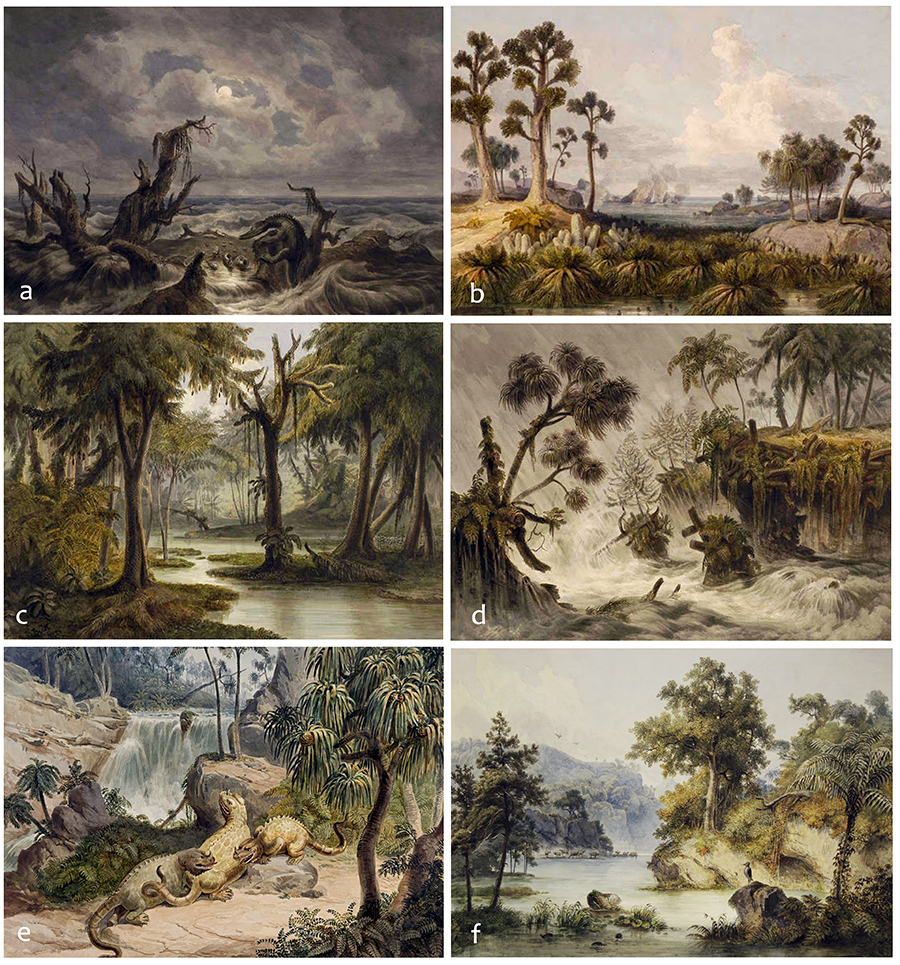
Figure 1. Watercolour works from the collaboration between Unger and Kuwasseg (Unger 1851). (a) Muschelkalk period (Late Triassic, 240–230 Ma): a desolate continental coastline with remains of ammonites (Ceratites nodosus) and Nothosaurus giganteus. Plant elements include Pinites goeppertanus (close to Voltzia), Endolepis, Neuropteris gaillardoti, and the alga Sphaerococcites blondowskianus. (b) Swamp environment during the “Transition” Period with Sigillaria, Calamites, Lomatophloyos crassicaule, Stigmaria ficoides, Annularia fertilis, Didymophyllon schottini, and Dëchenia euphorbioides. (c) Coal Formation Period: a small island within a humid forest crossed by stagnant waters, dominated by Lepidodendron, tree ferns (Pecopteris), and other ferns (Hymenophyllites, Sphenopteris, Woodwardites, Trichomanites, Cyclopteris); a group of Calamites appears in the background. (d) Stormy scene in a Carboniferous forest with Lepidodendron, Sigillaria, Calamites, and tree ferns. (e) Humid forested environment of the Early Cretaceous (140–100 Ma) with “terrible monsters of the primitive world” (Iguanodon, Hylaeosaurus), tree ferns (Protopteris erosa), cycad-like plants such as Zamiostrobus crassus and Pterophyllum humboldtianum, and shrubby elements belonging to Pecopteris, Alethopteris, Sphenopteris, and Neuropteris huttoni. (f) Eocene reconstruction depicting the interior of a continent with a mountainous gorge crossed by a stream. In the middle ground appear broad-leaved lobed plants (Hightea), accompanied by legumes (Leguminosites) and climbing plants (Capanoides, Cucumites variabilis); in the foreground left stands Cupressites, while on the right a palm (Palmacites echinatus) is depicted. In the stream occur Trapa, Potamogeton, Nymphaea arethusae, and Villarsites ungeri, together with armoured turtles (Trionyx). Flying above are Haliaetos; Tantalus stands on the shore, and herds of Palaeotherium graze in the low meadows. The original nomenclature has been retained (Unger 1851). Public Domain/CC0.
Figura 1. Acuarelas fruto de la colaboración entre Unger y Kuwasseg (Unger 1851). (a) Período Muschelkalk (Triásico superior, 240–230 Ma): costa desolada de un continente con restos de ammonites (Ceratites nodosus) y Nothosaurus giganteus. Entre los elementos vegetales aparecen Pinites goeppertanus (próximo a Voltzia), Endolepis, Neuropteris gaillardoti y el alga Sphaerococcites blondowskianus. (b) Ambiente pantanoso durante el Período de “Transición”, con Sigillaria, Calamites, Lomatophloyos crassicaule, Stigmaria ficoides, Annularia fertilis, Didymophyllon schottini y Dëchenia euphorbioides. (c) Período de la Formación Hullera: pequeña isla en el interior de un bosque húmedo atravesado por aguas estancadas, dominado por Lepidodendron, helechos arborescentes (Pecopteris) y otros helechos (Hymenophyllites, Sphenopteris, Woodwardites, Trichomanites, Cyclopteris); al fondo aparece un grupo de Calamites. (d) Escena tormentosa en un bosque carbonífero con Lepidodendron, Sigillaria, Calamites y helechos arborescentes. (e) Ambiente forestal húmedo del Cretácico inferior (140–100 Ma) con “terribles monstruos del mundo primitivo” (Iguanodon, Hylaeosaurus), helechos arborescentes (Protopteris erosa), plantas tipo cícada como Zamiostrobus crassus y Pterophyllum humboldtianum, y elementos arbustivos pertenecientes a Pecopteris, Alethopteris, Sphenopteris y Neuropteris huttoni. (f) Reconstrucción del Eoceno que muestra el interior de un continente con un desfiladero montañoso atravesado por un arroyo. En segundo plano aparecen planifolios de hojas lobuladas (Hightea), acompañados por leguminosas (Leguminosites) y plantas trepadoras (Capanoides, Cucumites variabilis); en primer plano a la izquierda se observa Cupressites, mientras que a la derecha aparece una palmera (Palmacites echinatus). En el arroyo se encuentran Trapa, Potamogeton, Nymphaea arethusae y Villarsites ungeri, junto con tortugas acorazadas (Trionyx). Volando sobre la escena aparece Haliaetos; Tantalus se sitúa en la orilla y manadas de Palaeotherium pastan en las praderas bajas. Se ha respetado la nomenclatura original (Unger 1851). Dominio público/CC0.
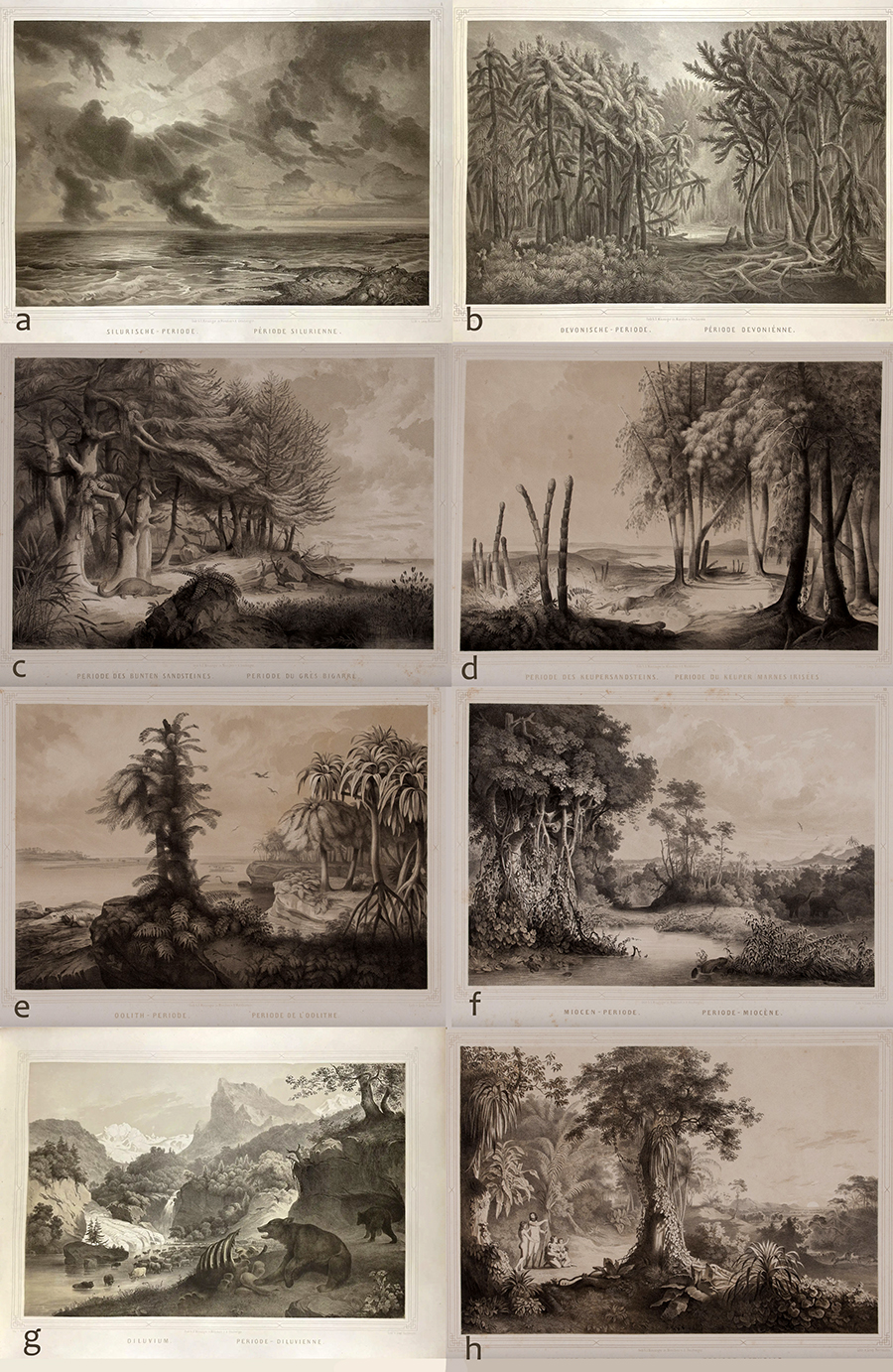
Figure 2. Lithographs produced by Rottmann (1797-1850) after the works of Kuwasseg, depicting the “development of the Earth” through different geological stages: (a) Silurian; (b) Devonian; (c) Buntsandstein; (d) Keuper; (e) Jurassic; (f) Miocene; (g) “Diluvium” in the Alps (Pleistocene); (h) “Present” period. Source: Historical Archive of the University of Padua: https://phaidra.cab.unipd.it/. Landesmuseum Joanneum. Public Domain/CC0.
Figura 2. Litografías realizadas por Rottmann (1851) a partir de las obras de Kuwasseg, que representan el “desarrollo de la Tierra” a través de diferentes etapas geológicas: (a) Silúrico; (b) Devónico; (c) Buntsandstein; (d) Keuper; (e) Jurásico; (f) Mioceno; (g) “Diluvium” en los Alpes (Pleistoceno); (h) período “actual”. Fuente: Archivo Histórico de la Universidad de Padua: https://phaidra.cab.unipd.it/. Landesmuseum Joanneum. Dominio público/CC0.
From a contemporary perspective, the Unger–Kuwasseg reconstructions exhibit numerous limitations: taxonomic inaccuracies, simplified community structure, restricted geographic sampling largely confined to Central Europe, and an incomplete understanding of stratigraphic relationships. Unger was not trained as a geologist, and many formations used as references were poorly characterized in paleoenvironmental terms. These shortcomings, however, do not diminish the scientific interest of the project. On the contrary, they make explicit the inferential character of paleoart. The series demonstrates how visual reconstruction operates at the boundary between empirical evidence, informed inference, and hypothesis. Crucially, the images do not conceal uncertainty; instead, they embody it in compositional choices, selective emphasis, and omissions. This transparency aligns closely with contemporary approaches to botanical paleoart, where uncertainty is managed rather than eliminated.
This epistemic openness also reveals that paleoartistic reconstructions are shaped not only by available evidence, but by the scientific priorities and cultural values of their time. In this respect, the Unger–Kuwasseg project stands out as a remarkable exception within nineteenth-century visual culture. Rather than organizing deep-time narratives around spectacular fossil animals, the series assigns plants chronological, ecological, and narrative agency, anticipating current efforts to overcome the zoocentric perspective and the plant blindness that have long characterized representations of ancient ecosystems.
Rudolph Zallinger and the Renaissance imprint on paleoart
Contemporary with Zdeněk Burian, Rudolph Zallinger (1919–1995; Pulitzer Prize for Painting in 1949) approached paleoartistic landscape through a visual logic that resonates with pictorial traditions predating the modern consolidation of landscape painting as an autonomous genre. To understand the compositional principles underlying his work, it is necessary to look back both to pre-Renaissance symbolic landscapes and to Renaissance representations of nature, in which spatial organization relied more on the hierarchy and disposition of volumes than on atmospheric perspective or optical blur (Amorós, 2023). In Zallinger’s work, depth is constructed primarily through relative scale, superposition, and compositional order, rather than through loosened brushwork or the dissolution of form with distance.
This approach finds a clear parallel in the solutions developed by early landscape painters such as Joachim Patinir, widely regarded as the first Flemish landscape specialist (Amorós, 2023). Patinir’s synthesis of the real and the symbolic, achieved through the progressive use of colour to articulate extensive spatial planes, offers a compelling analogue to Zallinger’s panoramic compositions. The chromatic transitions that structure Patinir’s landscapes—warmer tones in the foreground, cooler hues receding into the distance—appear to have been implicitly assimilated into Zallinger’s paleoartistic vocabulary.
These influences reach their fullest expression in The Age of Reptiles (1943–1947), the monumental fresco secco extending over thirty-three metres that adorns the Great Hall of the Peabody Museum of Natural History at Yale (Volpe, 2010) (Fig. 3). Preceded by an extensive series of preparatory studies, the mural presents an exceptional pictorial continuity in which sharpness and clarity are maintained across the entire surface (Paul, 2000). Each segment of the fresco secco is densely informative, both anatomically and geomorphologically, but also floristically, allowing distinct vegetational architectures to be discerned for successive intervals of deep time. Chromatic surfaces are clean and uniform, with no visible brushstroke, deliberately distancing the work from impressionistic solutions and reinforcing an almost cartographic legibility of the landscape. The overall effect has often been described as that of a continuous garden-like space, evoking the tradition of the hortus conclusus, a conceptual framework central to the evolution of Western landscape imagery since the Middle Ages. In The Age of Reptiles, this notion is amplified by the fresco’s enveloping disposition, which unfolds along the hall in a nearly panoramic manner, reinforcing a sense of ecological and temporal unity (Fig. 3). This choice was not incidental. Zallinger was trained at Yale’s School of Fine Arts during a period of renewed interest in fresco painting, strongly encouraged by Lewis Edwin York, head of the painting department, who played a decisive role in selecting Zallinger for the project (Lescaze et al., 2017).
Zallinger’s artistic education included the study of Il Libro dell’Arte by Cennino Cennini, the late fourteenth-century treatise that codified the fresco tradition inherited from Giotto di Bondone (Cennini, 1932). This lineage is significant not only for its technical implications but also for its conception of pictorial space. Giotto’s break with medieval flatness and his early engagement with tridimensional space and naturalistic settings find a clear echo in Zallinger’s mural (Amorós, 2024). The landscape is densely saturated with trees, shrubs, and ground vegetation rendered independently of depth plane, embedded within scenes of strong narrative force but also of systematic classificatory intent. Vegetation does not function as generic backdrop, but as a structuring matrix of the scene.
From the perspective of spatial theory, this solution generates productive tension. As Panofsky (1973) observed, the transition from the classical conception of space—as an interval between bodies—to the modern idea of “systematic space” entails a profound reorganization of perspective. In the murals, both The Age of Reptiles and The Age of Mammals (https://peabody.yale.edu/explore/collections), this transition is palpable: figures sometimes appear arranged in a quasi-autonomous manner, reminiscent of classical spatial logic, while the unifying treatment of light, colour, and landscape seeks to overcome that discontinuity and produce a continuous depth field (Fig. 3). This paradox—the coexistence of a figure-centred spatial logic with an overarching aspiration to landscape unity—confers upon Zallinger’s fresco a singular status in the history of paleoart. His work does not merely translate paleontological knowledge into visual form, but materializes an exceptional aesthetic synthesis in which artistic tradition, scientific representation, and landscape construction converge into a uniquely coherent visual language.
At the same time, this visual language reflects the scientific and cultural priorities of its historical context. Although vegetation provides the ecological framework that organizes the mural and distinguishes successive geological intervals, the narrative remains centered on vertebrate evolution, especially reptiles. Zallinger's work therefore occupies an intermediate position in the history of botanical paleoart: it grants plants a far more significant ecological role than was customary in twentieth-century paleoart, yet it still reflects the predominantly zoocentric narrative that shaped public representations of prehistoric life.
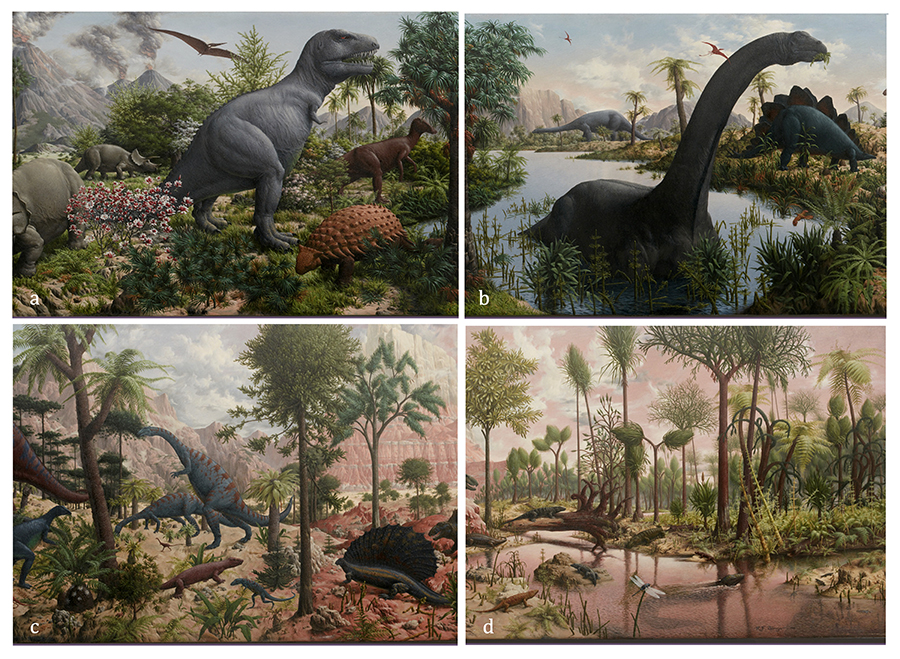
Figure 3. Zallinger’s The Age of Reptiles mural. Main plant and animal genera from left to right: (a) Cretaceous: Magnolia, Quercus, Pteranodon, Cornus, Ginkgo, an arecaceous palm, Tyrannosaurus, Sassafras, Ankylosaurus, Pandanus, Anatosaurus. (b) Jurassic: Rhamphorhynchus, Williamsonia, Brontosaurus, Neocalamites, Stegosaurus, Schizoneura, Archaeopteryx, Matonidium. (c) Triassic: Williamsonia, Wielandiella, Cycadeoidea, Plateosaurus, Podokesaurus, Cynognathus, Saltoposuchus, Macrotaeniopteris, Araucarioxylon, Bjuvia, Edaphosaurus. (d) Carboniferous–Devonian: Cordaites, Limnoscelis, Ophiacodon, Varanosaurus, Seymouria, Meganeura, Sigillaria, Eryops, Diplocaulus, Eogyrinus, Eusthenopteron, Lepidodendron, Eospermatopteris, Calamites, Cheirolepis. Courtesy of the Yale Peabody Museum.
Figura 3. Mural The Age of Reptiles de Zallinger. Principales géneros vegetales y animales de izquierda a derecha: (a) Cretácico: Magnolia, Quercus, Pteranodon, Cornus, Ginkgo, una palmera arecácea, Tyrannosaurus, Sassafras, Ankylosaurus, Pandanus, Anatosaurus. (b) Jurásico: Rhamphorhynchus, Williamsonia, Brontosaurus, Neocalamites, Stegosaurus, Schizoneura, Archaeopteryx, Matonidium. (c) Triásico: Williamsonia, Wielandiella, Cycadeoidea, Plateosaurus, Podokesaurus, Cynognathus, Saltoposuchus, Macrotaeniopteris, Araucarioxylon, Bjuvia, Edaphosaurus. (d) Carbonífero–Devónico: Cordaites, Limnoscelis, Ophiacodon, Varanosaurus, Seymouria, Meganeura, Sigillaria, Eryops, Diplocaulus, Eogyrinus, Eusthenopteron, Lepidodendron, Eospermatopteris, Calamites, Cheirolepis. Cortesía del Yale Peabody Museum.
Botanical paleoart and Quaternary paleoecology: from precedents to an integrated research framework
Explicitly botanical reconstructions of Quaternary landscapes remain relatively uncommon. As in Miocene and Pliocene contexts, many of the best-known examples are concentrated in hominin-related settings, where vegetation is used to contextualize human evolution and behavior (Turner and Antón, 2007; Agustí and Antón, 2013; Ferrández-Verdú et al., 2023; Carrión et al., 2024a, 2024b, 2026a, 2026b; Amorós et al., 2025; Amorós and Carrión, 2025, 2026). One advantage of the Quaternary record is that much of its vegetation corresponds to extant species, even if their current distributions have been displaced by climatic change or human impact. However, translating paleoecological proxies—especially pollen data—into visual form is not a mechanical exercise. Pollen diagrams are inherently fragmentary and scale-dependent, integrating both local and regional signals (Birks et al., 2016). As a result, Quaternary botanical paleoart requires interpretive visual decisions that do not always align with photographic naturalism.
Excessive realism may obscure diagnostic traits, whereas a deliberately selective visual grammar—emphasizing leaves, growth form, fruits, flowers, and habit—can enhance taxonomic legibility and, crucially, make visible the ecological logic of refugial landscapes (Amorós et al., 2021). In the Iberian context, an early and methodologically robust precedent is the volume edited by Villaverde (2001) on Paleolithic and Neolithic contexts in Valencia, illustrated by Carles Puche. Several contributions translated anthracological and palynological data into botanically and faunistically informed scenes. More recently, the editorial project Iberian Paleofloras has assembled an extensive body of geobotanical illustration spanning the Paleocene to the Holocene, with an explicit emphasis on situating fauna within floristically and topographically resolved contexts, including dioramas conceived as catenas of paleovegetation (Carrión et al., 2024c, 2024d, 2024e). Some of these Cenozoic catenas, derived from pollen diagrams and macrofossil inventories, were developed using a visual synthesis protocol designed to reinforce the spatial dimension of paleoecology.
Several of these pilot studies demonstrate the methodological potential of botanical paleoart in Quaternary contexts. At Cova de Bolomor, high-resolution palynological records revealed recurrent Neanderthal occupations in wooded environments over hundreds of thousands of years, challenging the stereotype of uniformly open steppe landscapes. The scenes shift emphasis away from hunting episodes toward human–ecosystem interactions, functioning simultaneously as didactic tools and visual arguments for altitudinal gradients and refugial mosaics (Amorós et al., 2021). In the Lower Pleistocene of Orce, a comparable integration was achieved through digital paintings based on pollen records from multiple sites and an explicitly declared methodology: taxa were first drawn with diagnostic traits (fruits, inflorescences, growth form), then assembled into composite landscapes, and finally accompanied by transparent conventions where proxies imposed limits (e.g., color codes or generic morphotypes) (Carrión et al., 2024a). At Pešturina in the central Balkans, multi-scalar reconstructions combined cave pollen (including coprolites) with regional sequences to contrast glacial and interglacial conditions and emphasize refugial persistence and altitudinal shifts among steppe, conifer, and broadleaf communities (Carrión et al., 2024b). At Isturitz, where direct botanical proxies were more limited, visual reconstruction relied more heavily on zooarchaeological and isotopic data integrated with regional paleoenvironmental knowledge, demonstrating that Quaternary paleoart can function as a heuristic bridge even under constrained botanical evidence (Berlioz et al., 2025).
Carrión et al. (2026a) presented four botanical reconstructions for the Quípar–Segura Basin (southeastern Iberia), conceived as scenes with explicit botanical grammar. Three are based on the Cueva del Arco sequence (Carrión et al., 2025): a Mousterian landscape dominated by pine and juniper woodlands; a Gravettian scenario in karstic relief with shallow lithosols; and a riparian refuge within fluvial gorges compatible with multiple cultural phases. A fourth reconstruction reaches back to the end of the Lower Pleistocene, drawing on the palynological record of Cueva Negra del Estrecho del Río Quípar, where the coexistence of evergreen and deciduous oaks with conifers and riparian elements highlights the refugial character of the basin (Carrión et al., 2003).
Within this broader framework, recent syntheses of Neanderthal landscapes explicitly challenge the cliché of a uniformly cold and treeless Pleistocene, proposing regional “chronicles” based on pollen, charcoal, and macrofossils that restore spatial and temporal habitat diversity (Carrión et al., 2026b). These perspectives converge with continental-scale palynological modeling using REVEALS and LOVE, which suggests that during the Last Interglacial much of the European temperate biome consisted of open woodlands maintained by disturbance and megaherbivory—an inference that has been translated into paleoartistic reconstructions visualizing this heterogeneity (Pearce et al., 2023, 2025).
Many of the former artworks were developed under the auspicies of the ECCE HOMO research group (University of Murcia) with two complementary pillars: (i) a digital archive of more than 200 Cenozoic plant taxa represented through multiple morphotypes, conceived both as an aesthetic resource and as a taxonomically robust reference; and (ii) the systematic use of large Iberian paleobotanical databases to select and ecologically calibrate the assemblages depicted. Within this approach, the most demanding phase is not illustration per se, but prior paleoecological research, understood as a forensic synthesis of diverse proxies—chronology and stratigraphy, pollen, macroremains, phytoliths, charcoal, ancient DNA, isotopes, biomarkers, paleohydrology, paleoclimate, archaeology, coprolites, and ecological modeling—aimed both at updating existing interpretations and at generating hypotheses where data gaps persist (Carrión et al., 2026a, 2026b). As a continuation of a pictorial series addressing vegetation changes during the Pleistocene in the interior of eastern Andalusia (Carrión et al., 2026b), we present here a new paleoartistic reconstruction for the Holocene of the Píñar River valley, based on palynological data from the archaeological site of Carihuela Cave, Granada (Carrión, 1992; Carrión et al., 1998; Fernández et al., 2007; Carrión et al., 2019). This reconstruction is consistent with other regional palynological studies, such as Padul (Camuera et al., 2019) and Los Tollos (Carrión et al., 2024f) (Fig. 4).
Unlike many traditional paleoartistic reconstructions, these landscapes were not conceived around human or animal protagonists, but around vegetation as the principal organizer of ecological space. The distribution of woodland patches, open grasslands, riparian communities, and rocky habitats reflects explicit paleoecological hypotheses derived from palynological and macrofossil evidence rather than compositional conventions inherited from classical paleoart. In this sense, the images deliberately seek to overcome the zoocentric perspective and the plant blindness discussed above, presenting vegetation not as scenic background but as the primary agent structuring habitat diversity, animal distribution, and human occupation.
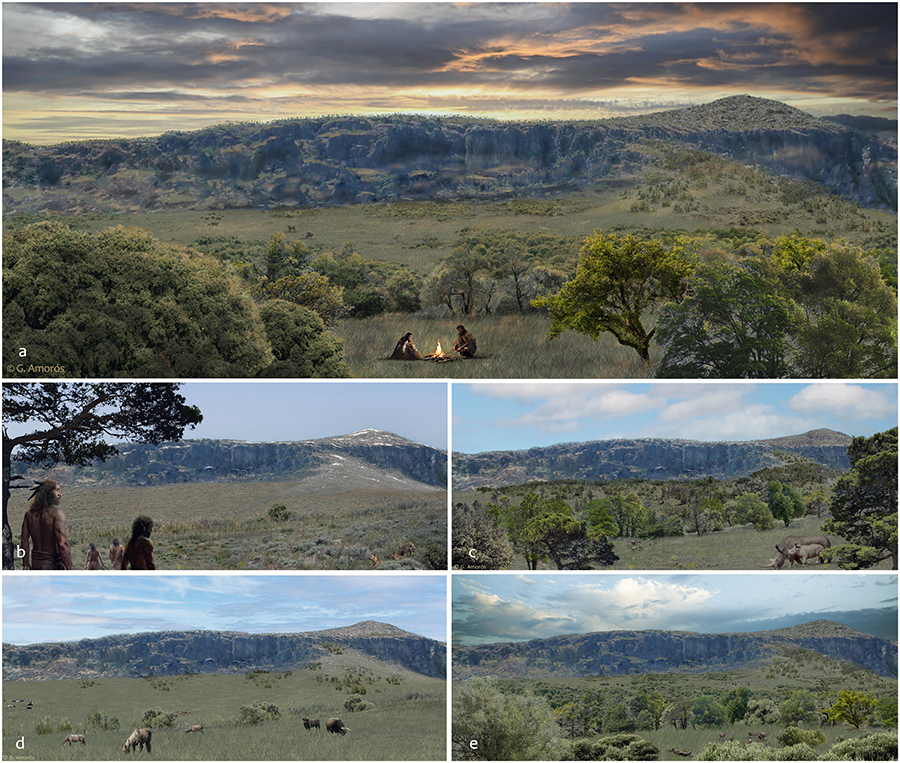
Figure 4. Paleoartworks depicting late Quaternary phases in the Píñar Valley, adjacent to Carihuela Cave, a well-known Neanderthal site in southern Iberia. The area, located at ~1000 m a.s.l., currently experiences a continental Mediterranean climate. (a) Holocene landscape dominated by Quercus and Olea. (b) Full-glacial environment characterized by Artemisia-dominated vegetation. (c) Interstadial conditions with woodlands of Pinus nigra, Juniperus, and several Quercus species developing in areas with greater soil moisture; Dicerorhinus kirchbergensis appears in the foreground. (d) Stadial landscape dominated by grass steppe, with intense herbivory inferred from faunal remains including Bos, Cervus, and Equus; phreatophytic vegetation is represented along the river margins. (e) Last Interglacial environment with woodlands dominated by Quercus and Olea, a central riparian gallery of willows, ashes, alders, and elms, and pines growing on more exposed and rocky slopes; megaherbivore activity may have generated locally more open patches within the forest. Artwork by Gabriela Amorós, digitally adapted from Carrión et al. (2026b) in b–e.
Figura 4. Paleoarte que representa fases tardocuaternarias en el valle de Píñar, adyacente a la Cueva de Carihuela, un conocido yacimiento neandertal del sur de Iberia. El área, situada a ~1000 m s.n.m., presenta actualmente clima mediterráneo continental. (a) Paisaje holoceno dominado por Quercus y Olea. (b) Ambiente de pleno glacial caracterizado por formaciones dominadas por Artemisia. (c) Condiciones interestadiales con bosques de Pinus nigra, Juniperus y diversas especies de Quercus desarrollándose en zonas con mayor humedad edáfica; Dicerorhinus kirchbergensis aparece en primer plano. (d) Paisaje estadial dominado por estepas herbáceas, con intensa herbivoría inferida a partir de restos faunísticos de Bos, Cervus y Equus; la vegetación freatofítica se representa en las márgenes del río. (e) Ambiente del Último Interglacial con bosques dominados por Quercus y Olea, una galería riparia central con sauces, fresnos, alisos y olmos, y pinos creciendo en laderas más expuestas y rocosas; la actividad de megaherbívoros pudo generar claros locales dentro del bosque. Ilustración de Gabriela Amorós, adaptada digitalmente de Carrión et al. (2026b) en b–e.
Towards an aesthetics of uncertainty in botanical paleoart
Botanical paleoart has until very recently remained a scarcely explored and rarely systematized domain (Marchetti et al., 2015; Kustatscher et al., 2019, 2024; Klages et al., 2020; Vujaković, 2019; Amorós et al., 2021; Spicer et al., 2021; Trümper et al., 2023; Pearce et al., 2023, 2025; Amorós et al., 2025; Carrión et al., 2024a, 2024b, 2026a, 2026b). In this sense, it can be regarded as a pioneering professional practice, still far from having achieved a routine or standardized disciplinary status. This condition is accompanied by a broad array of problems, open questions, and methodological challenges. When an artist undertakes a paleoenvironmental reconstruction, their dependence on paleontological and paleoecological interpretation is explicit. When, however, the paleoscientist themselves engages in paleoartistic reconstruction, the challenges multiply considerably, often exceeding what is anticipated in conventional research workflows or contingency planning.
The fragmentary nature of the plant fossil record
A vast proportion of fossil plants has never been graphically or artistically represented, largely as a consequence of the fragmentary nature of the plant fossil record, compounded by the relatively small number of specialists in paleobotany compared to other organismal groups. Roots, trunks, leaves, seeds, reproductive organs, pollen grains, and spores commonly occur in isolation, lacking clear anatomical or biological connections (Carrión, 2003; Kenrick and Davis, 2004; Cleal and Thomas, 2009; Taylor et al., 2009; Krings et al., 2022). These elements constitute disconnected pieces of a complex investigative puzzle whose ultimate aim is the reconstruction of the whole plant, followed by its specific definition and taxonomic placement. While this phenomenon is general in paleobotany, it becomes especially evident—and almost dramatic—when fossil data are translated into visual representations of past vegetated landscapes. In this transition, the silences of the fossil record may become truly deafening.
Undrawable taxa in palynological records
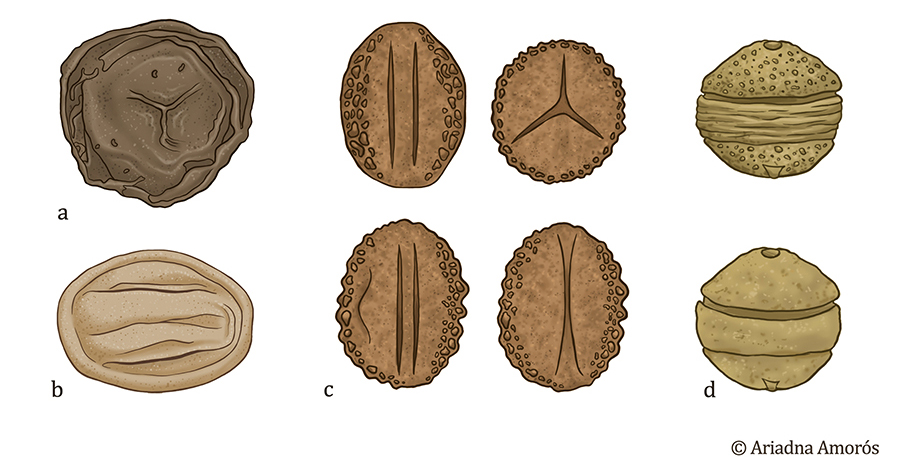
An illustrative example of the limitations of the plant fossil record is provided by the Mesozoic pollen Eucommidites (Fig. 5). This morphotype exhibits relatively high abundances and species diversity, and broad paleogeographic distribution (Hofmann et al., 2026). This apparent ecological success contrasts sharply with the profound uncertainty surrounding its biological origin. Proposed affinities have included Gnetales, Erdtmanithecales, Bennettitales, Caytoniales, other unassigned Mesozoic gymnosperms, and even extinct basal angiosperms (Hughes, 1994; Taylor et al., 2009; Devesa and Carrión, 2017). Although Eucommidites pollen grains have been documented in situ within the micropyle and pollen chamber of gymnosperm ovules such as Spermatites, Allicospermum, and Eucommiitheca, as well as in cycad cones (Hastystrobus) and associated with the micropilar tube of gnetophytes and bennettitaleans (Traverse, 2007; Taylor et al., 2009), these associations do not resolve the problem but instead reinforce the hypothesis of palynomorphological convergence. Hence, a fundamental question is raised for visual reconstruction: how can landscapes be depicted when one of their dominant components is, morphologically speaking, essentially invisible?
Another palynological group in which evolutionary convergence may have played a role in linking a single palynotype to different taxa is Classopollis (
Fig. 5). Although it is generally associated with Hirmerella (formerly Cheirolepis), this circumpolloid pollen type shows also affinities with other non-cheirolepidiaceous conifers. In any case, Classopollis also illustrates the intrinsic paleoecological value of a palynomorph, as it is typically associated with warmth-loving plant communities and shows a sharp decline in abundance with increasing latitude (Traverse, 2007). This problem is exacerbated when considering pollen morphotypes with putative angiosperm affinities, such as the Crinopolles group and other reticulate–columellate grains from the Triassic (Cornet, 1989; Friis et al., 2011).
Figure
5. Scientific illustration of microfossils
(spores and pollen grains). (a) Calamospora, ranging from the Devonian to the Permian. (b) Eucommidites, characteristic of the Jurassic–Early Cretaceous. (c) Crinopolles group, reported from the Triassic but most abundant in the Early
Cretaceous. (d) Classopollis, typical of the Late Triassic to Cretaceous. Artworks by Ariadna
Amorós. Figura 5. Ilustración
científica de microfósiles (esporas y granos de polen). (a) Calamospora, con registro
desde el Devónico hasta el Pérmico. (b) Eucommidites, característico del
Jurásico–Cretácico inferior. (c) Grupo Crinopolles, citado desde el Triásico pero
especialmente abundante en el Cretácico inferior. (d) Classopollis, típico del
Triásico superior al Cretácico. Ilustración por Ariadna Amorós. Numerous
additional pollen and spore types exhibit high abundance and recurrence despite
ambiguous or unknown botanical affinities (Stewart
and Rothwell, 1993; Doyle, 2005; Traverse, 2007). Among Mesozoic pollen types, Exesipollenites,
occasionally associated with Williamsoniella
(Peñalver
et al., 2015), largely
lacks unequivocal reproductive anchoring. Broad morphogenera such as Cycadopites illustrate how a
“cycad-like” appearance may mask producers belonging to cycads,
bennettitaleans, or other spermatophytes. In the Permian–Triassic transition,
bisaccate pollen such as Alisporites
has been alternatively attributed to several orders of pteridosperms and early
conifers without uniform resolution (Krassilov, 1997). In the Paleozoic, the problem intensifies further:
widely distributed trilete spores such as Calamospora
exemplify the dissociation between microfossil record and whole-plant
reconstruction (Doweld, 2017), while
Silurian–Devonian cryptospores (Retusotriletes,
Ambitisporites,
dyads and tetrads) point to a world of early embryophytes with debated
affinities (Neregato and Hilton, 2019; Strother, 2000). Granulatisporites spores have been found in
the fern Botryopteris, the lyginopterid Feraxotheca and Crossotheca,
several sphenopsids and the early Devonian rhyniophyte Rhynia (Jansonius
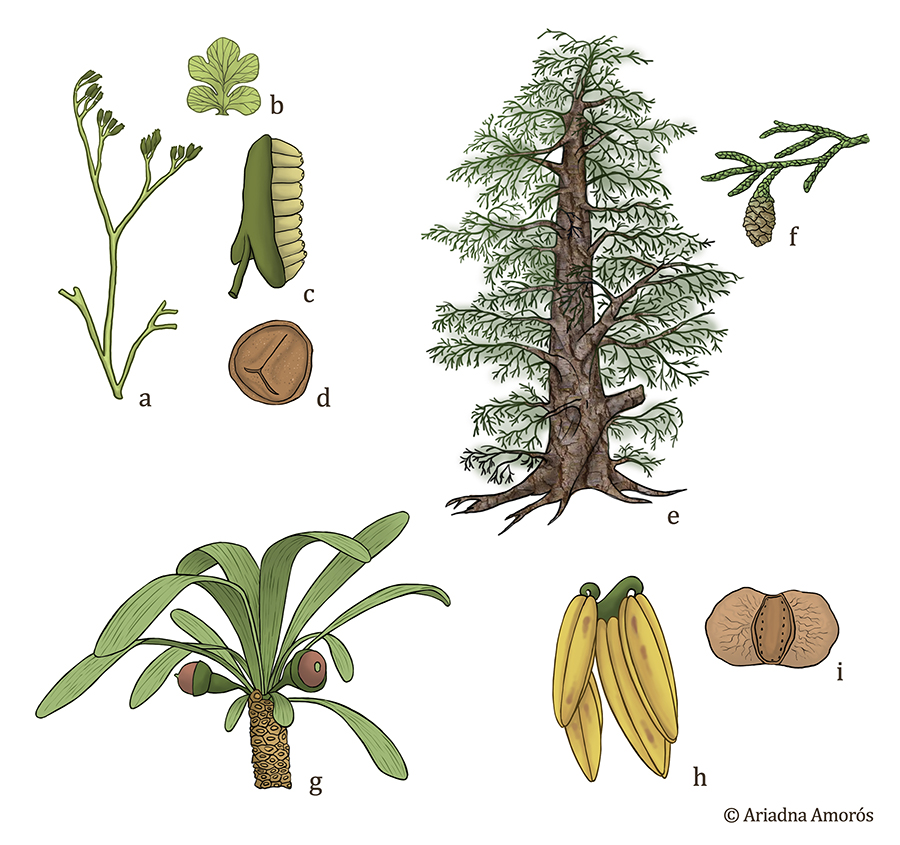
and McGregor, 1996) (Fig. 6). Collectively, these fossil taxa
highlight a structural limitation of botanical paleoart: in many intervals
—particularly older ones—stratigraphically characteristic and/or dominant
palynological signals cannot be reliably translated into drawable plants,
necessitating explicit acknowledgment of uncertainty in landscape
reconstructions.
Figure
6. Scientific illustration of selected plant
macrofossils and microfossils discussed in this article. (a–e)
Lyginopteridales, Late Carboniferous (modified from Stewart and Rothwell, 1993 and Devesa and
Carrión, 2017): (a) Lyginorachis, fertile frond bearing cupulate seeds; (b) pinnule of Lyginopteris oldhamia; (c) Crossotheca, synangium with pollen sacs; (d) typical pollen of
Lyginopteridaceae with trilete aperture; (e) Cheirolepidiaceae tree, modified
from Cleal y Thomas (2009). (f) Hirmeriella, fertile branch with gynostrobilus. (g) Nehvizdyella bipartita from the Late Cretaceous of the Czech Republic, showing two seeds
and a cupule homologous to that of Ginkgo
(redrawn from Taylor et al., 2009 and Devesa and
Carrión, 2017). (h) synangia of Caytonanthus; (i) typical pollen of Caytoniaceae. Images © 2026 Ariadna Amorós. Figura 6. Ilustración
científica de algunos macrofósiles y microfósiles vegetales discutidos en este
artículo. (a–e) Lyginopteridales, Carbonífero superior (modificado de Stewart y Rothwell, 1993 y Devesa y Carrión, 2017): (a) Lyginorachis, fronde
fértil con semillas cupuladas; (b) pínnula de Lyginopteris oldhamia; (c)
Crossotheca,
sinangio con sacos polínicos; (d) polen típico de Lyginopteridaceae con
apertura trilete; (e) Cheirolepidiaceae, porte arbóreo, modificado de Cleal y Thomas (2009). (f) Hirmeriella rama fértil
con ginostróbilo. (g) Nehvizdyella
bipartita del Cretácico superior de la República Checa, con dos
semillas y una cúpula homologable a la de Ginkgo
(redibujado de Taylor et al., 2009 y Devesa y Carrión, 2017). (h) sinangios de Caytonanthus; (i)
polen típico de Caytoniaceae. Imágenes © 2026 Ariadna Amorós. Architectural
ambiguity in the macrofossil record Another major
challenge arises from petrified woods and isolated axes, which are frequently
disconnected from foliar and reproductive organs (Taylor et al., 2009). Even when anatomical preservation is
excellent, reconstruction remains inferential. The recent study of Shanxioxylon yangquanense, a
Late Carboniferous cordaitalean axis from northern China (Wang et al., 2025), demonstrates that detailed anatomical
characterization alone does not suffice to reconstruct habit, architecture, or
ecological role. The absence of reproductive organs, root systems, and in
situ associations limits the translation of such fossils into visually
defined plants within a landscape. This difficulty is compounded by the vast
record of Mesozoic foliage, whose correlation with major plant groups remains
highly problematic (Wagner and Álvarez-Vázquez, 2010; Carrión et al., 2024c). In some cases, entire groups can only be
distinguished on the basis of stomatal characters, as in many bennettitaleans
and cycads (Crepet, 1972).
Equally problematic is the persistence of excessive simplification and the
uncritical reproduction of outdated models—for example, the recurrent depiction
of Walchia as Araucaria heterophylla,
despite substantial anatomical and architectural differences (Carrión et al.,
2026a). Prototaxites constitutes perhaps the most extreme and didactic example of fluctuating
interpretation in the history of paleobotany. Since its original description in
the nineteenth century (Dawson, 1859), this giant Silurian–Devonian organism has been
successively interpreted as a primitive vascular plant, a macroscopic alga, a
lichen, a giant fungus, or a composite vegetal structure, reflecting the
difficulty of fitting its tubular anatomy into modern taxonomic frameworks (Taylor et al.,
2010, 2015). In the early twenty-first century, the
fungal hypothesis gained broad acceptance, supported by analogies with complex
hyphal systems and isotopic evidence compatible with heterotrophic nutrition,
giving rise to a dominant paleoartistic iconography depicting Prototaxites as large,
vertically emerging fruiting bodies rising above early Devonian landscapes (Hueber, 2001). Subsequent
revisions, however, questioned this interpretation by identifying key
anatomical inconsistencies—such as annular wall thickenings incompatible with
fungal hyphae—and the absence of fossilization products derived from chitin or
chitosan, diagnostic of extant and fossil fungi (Graham et al., 2010). More recently, Vajda et al. (2023) proposed a reinterpretation of Prototaxites as
mega-rhizomorphs comparable to those of Armillaria,
characterized by preferentially horizontal growth and a primary function in
redistributing water and nutrients across early terrestrial ecosystems. This
model implies a radically different paleoartistic representation, shifting from
vertical, tree-like forms to extensive, ground-level or subsurface networks. In
parallel, high-resolution molecular and chemical analyses of exceptionally
preserved material from the Rhynie chert have revealed a chemical signature
rich in aromatic and phenolic compounds, distinct from those of plants, fungi,
algae, or other known eukaryotes, leading to the proposal that Prototaxites may represent a
fully extinct lineage of multicellular terrestrial eukaryotes without modern
analogues (Loron et al., 2025).
Taken together,
the interpretative history of Prototaxites
illustrates how even abundant, macroscopic, and iconic fossils may remain
conceptually unassignable for decades, and how each biological hypothesis
generates a radically different paleoartistic image. From the perspective of
botanical paleoart, this case demonstrates that visual reconstruction does not
merely translate knowledge, but also materializes uncertainty, and that in
certain contexts the ontological provisionality of the reconstructed organism
must be made explicit. Integration
of evidence and visual decision-making From a methodological standpoint, it is
essential to establish explicitly the framework, perspective, and scale from
which taxonomic, ecological, and biogeographical insights are extracted from
the fossil record (“Art is limitation; the essence of every picture is the
frame”—G. K. Chesterton). Decisions regarding spatial scale—whether landscapes,
communities, populations, groups of individuals, or individual plants—must be
made consciously and justified. Although plants do not meet strict criteria for
eusociality, they display analogous traits such as mycorrhizal mutualisms, kin
recognition, and resource sharing, which should be visually translated into
paleoecosystems when supported by evidence. The heterogeneity of available data and
analytical approaches poses additional challenges. Palynological analysis often
constitutes the primary source for reconstructing past vegetation, and paleoart
may be understood as the logical culmination and visual synthesis of such
diagrams (Carrión et al., 2024a, 2024b). However, the integration of macrofossil data and quantitative
modeling substantially enhances the robustness and reliability of
reconstructions. Recent methodological advances include REVEALS, LOVE, the
Landscape Reconstruction Algorithm (LRA), the Modern Analogue Technique (MAT),
WA-PLS, and biomization approaches, all of which contribute complementary
constraints on vegetation composition and structure. These methodological limitations and
integrations directly condition the visual strategies adopted under conditions
of incomplete knowledge. In such contexts, visual representations should
prioritize taxonomic clarity and evidential transparency over strict
photorealism. Fragmentary plants may be depicted as fallen trunks, partial
individuals, or background elements that display only those features that can
be reconstructed with confidence (Carrión et al., 2026a). Aerial or elevated perspectives can increase taxonomic visibility
in highly diverse landscapes, while emphasizing modularity, developmental
variation, and multiple plausible growth forms reflect both the evolutionary
flexibility of plants and the fragmentary nature of the fossil record (Herrera, 2009; Rothwell et al., 2014). Paleoart thus becomes a means of restoring fossil organisms to
their ecological context while simultaneously making explicit the epistemic
limits of current knowledge. Final reflections Paleoart that
rigorously incorporates the plant component of landscapes—both in its taxonomic
and ecosystemic dimensions—is not a new practice, but its historical
development has been discontinuous. As shown throughout this article, already
in the nineteenth century there were representations displaying a remarkable
degree of botanical detail; nevertheless, botanical paleoart remained a
marginal current, often treated in a picturesque or secondary manner (Carrión et al.,
2026a). The general
trajectory of paleoart has been dominated by a pronounced zoocentrism, in a way
analogous to how certain reductionist approaches have prevailed in other areas
of biology (Rosenberg, 2006). In
recent decades, however, a gradual—still fragile, but significant—expansion of
interest in plants within paleoecological reconstructions can be observed. Much remains to be
done, particularly in methodological terms and in the training of new
professionals capable of integrating paleobotany, paleoecology, and scientific
visualization. In a context marked by the proliferation of digital tools and by
a visual market in which authorship and quality control are not always
transparent, it is not surprising that scientific communities maintain a
cautious attitude toward the epistemological status of paleoart. From this
perspective, botanical paleoart may be understood today as a still incipient
phase in the development of the discipline, albeit one with considerable
potential for growth. The question of
whether paleoart should be considered “science-informed art” or an integral
part of scientific practice is, ultimately, secondary to what it effectively
produces. Reconstructions do not merely illustrate prior knowledge: they
generate new forms of understanding. Goethe, in The Metamorphosis of Plants (Goethe, 1790), showed how a visual archetype could
reveal the coherence of a system; analogously, a Carboniferous forest is not
simply an enumeration of taxa, but an ecological atmosphere. The well-known sapere vedere attributed to
Leonardo da Vinci encapsulates this idea: drawing is also a way of reasoning.
Within this tradition, paleoart may be understood as a form of visual science,
comparable to pollen and charcoal diagrams, chronological charts, cladograms,
climate models, or ecological simulations, —representations that are
necessarily provisional— yet indispensable for integrating evidence and
rendering deep time intelligible. This role is
equally cultural. As Rosenberg and Burke (2022) point out, paleoart reflects human values as much as
extinct organisms, from classical myths to contemporary visions of dystopian
futures. It is not a mere ornament, but simultaneously a scientific hypothesis
and a cultural archive, a bridge between the paleosciences and society.
However, that bridge has largely been constructed from an animal-centered
perspective. Moving forward requires recovering paleobotany as well, too often
relegated to the background of the scene. Plants were fundamental agents in shaping
climates, soils, and evolutionary opportunities (Beerling, 2007; Balas and Momsen, 2014; Jose et al., 2019); ignoring them substantially impoverishes our
reading of the past. Botanical paleoart goes beyond taxonomic identification,
and at the same time, it highlights the need to consolidate a professional
space that remains poorly defined but is rich in scientific, educational,
artistic, and ethical possibilities. Its potential impact extends beyond
paleoscience, contributing to the formation of new sensibilities and to
fostering respect for nature in a context of environmental crisis. Ultimately,
integrating paleobotanical evidence into paleoart should not be understood as
an ornamental addition, but as a structural axis of paleoenvironmental
reconstruction. In this sense, the history of science repeatedly reminds us
that progress often emerges from the capacity to reconceptualize problems
through new representational frameworks. Peter Medawar famously argued in The Art of the Soluble that
“the art of research is the art of making difficult problems soluble by
devising means of getting at them” (Medawar, 1967), underscoring that scientific inquiry, like artistic
practice, relies on ingenuity, imagination, and the creation of adequate forms
of representation. This convergence between scientific reasoning and creative
visualization has been further explored by Tom McLeish (2019), who emphasizes that understanding nature
requires not only analytical rigor but also narrative, metaphor, and form. Botanical
paleoart, situated at this intersection, exemplifies how visual synthesis can
dissolve disciplinary boundaries, integrate disparate lines of evidence, and
address complex questions —such as long-term environmental change— that resist
purely reductionist approaches. By foregrounding plants as active agents in
Earth’s history, paleoart can thus contribute not only to more robust
reconstructions of past ecosystems, but also to a broader, more integrated
scientific culture capable of responding to contemporary global challenges. Authors' contributions Conceptualization: G. Amorós; S.
Conesa & J.S. Carrión. Investigation: G. Amorós;
J.S. Carrión; S. Conesa & A. Amorós. Visualization: G.
Amorós; A. Amorós & S. Conesa. Funding Acquisition: J.S.
Carrión. Writing: G. Amorós; J.S. Carrión &S. Conesa. Data and Code Availability This article does not use data sets Funding, required permits, potential
conflicts of interest, and acknowledgments This research was funded by the projects
HOMEDSCAPE (grant PID2022-136832NB-100) and Fundación Séneca (grant
22525/PI/24). The authors declare that they have no
conflict of interest. We are grateful to Erin Gredel (Yale
Peabody Museum, New Haven) for facilitating the museum permissions required to
reproduce the work of Rudolph Zallinger. References Agamben, G. (2017). Creation
and anarchy: The work of art and the religion of capitalism. Stanford University Press, Stanford,
CA, USA. ISBN: 9781503609273 Agustí, J.,
& Antón, M. (2013). La gran migración: La evolución humana
más allá de África. Editorial Crítica, Barcelona, Spain. ISBN: 978-8498925586 Amorós, G. (2023). Paleoarte y naturaleza: análisis
historiográfico del paisaje neandertal. Doctoral
thesis, University of Murcia, Murcia, Spain. http://hdl.handle.net/10201/129404 Amorós, G. (2024). Paleoarte y paisaje: una teoría estética.
Servicio de Publicaciones, Universidad de Murcia, Murcia, Spain. https://doi.org/10.6018/editum.3108 Amorós, G., & Carrión, J. S. (2025). The
kitsch dimension of paleoart. Arte,
Individuo y Sociedad, 37(1), 97299. https://doi.org/10.5209/aris.97299 Amorós, G., & Carrión,
J. S. (2026). The mismeasure of Neanderthals. Earth History and
Biodiversity, 7, 100036. https://doi.org/10.1016/j.hisbio.2025.100036 Amorós, G., Carrión, J. S., Ochando, J. & HOMOSCAPE
Project Members. (2021). Paleoecology and paleoart: landscapes of the Middle
Pleistocene Neanderthals in Bolomor Cave, Eastern Iberia. Quaternary Science Reviews, 256, 106826. https://doi.org/10.1016/j.quascirev.2021.106826 Amorós, G., Carrión, J. S., Crivellaro, F. & Marín-Arroyo, A. B.
(2025). Out of the cave: Rewilding deep time at the
Venice Biennale. iScience, 28(9), 113392. https://doi.org/10.1016/j.isci.2025.113392 Ansón, M., Hernández Fernández, M.
& Saura Ramos, P. A. (2015). Paleoart: term and conditions
(a survey among paleontologists). In, L. Domingo, R. Tomassini, C. Montalvo, A.
Abello, & M. H. Fernández (eds.), Current trends in paleontology and
evolution. XIII
Meeting of Early-Stage Researchers in Paleontology, Cercedilla,
Madrid, April 2015. Abstract Book (pp. 28–34). Balas, B.,
& Momsen, J. L. (2014). Attention ‘blinks’ differently for plants and animals. CBE—Life Sciences Education, 13, 437–443. https://doi.org/10.1187/cbe.14-05-0091 Balding, M.,
& Williams, K. J. H. (2016). Plant blindness and the implications for plant conservation. Conservation Biology, 30(6), 1192–1199. https://doi.org/10.1111/cobi.12738 Barreda, V. D., Cúneo, N. R., Wilf, P., Currano, E. D., Scasso, R. A. &
Brinkhuis, H. (2012). Cretaceous/Paleogene floral
turnover in Patagonia: Drop in diversity, low extinction, and a Classopollis spike. PLoS ONE, 7, e52455. https://doi.org/10.1371/journal.pone.0052455 Beans, C. (2022). Artists
join paleobotanists to bring ancient plants to life—and pique viewer interest. Proceedings of the National
Academy of Sciences of the United States of America, 119, e2201070119. https://doi.org/10.1073/pnas.2201070119
Beerling, D. J. (2007). The
emerald planet: How plants changed Earth’s history.
Oxford University Press, Oxford, UK. ISBN: 978-0192806024 Berlioz, E., Fernández-García, M., Soulier, M.-C., Agudo-Pérez, L., Amorós,
G., Normand, C., & Marín-Arroyo, A. B. (2025). Aurignacian groups at
Isturitz (France) adapted to a shifting environment upon their arrival in
Western Europe ∼42 000 years ago. Journal of Human Evolution,
202, 103665. https://doi.org/10.1016/j.jhevol.2024.103665 Birks, H. J. B., Felde, V. A., Bjune, A. E., Grytnes, J.-A., Seppä, H.
& Giesecke, T. (2016). Does pollen-assemblage richness reflect floristic
richness? A review of recent developments and future challenges. Review of Palaeobotany and
Palynology, 228,
1–25. https://doi.org/10.1016/j.revpalbo.2015.12.011 Bressan, D. (2012). Plant paleoart through the ages. Scientific
American Blogs: History of Geology. Retrieved from http://blogs.scientificamerican.com/history-of-geology/2012/11/23/plant-paleoart-through-the-ages/
(accessed 12 November 2025). Brockman, J. (1995). The
third culture: Beyond the scientific revolution. Simon & Schuster, New York, NY, USA. ISBN: 978-0684803593 Camuera, J., Jiménez-Moreno, G., Ramos-Román, M. J., García-Alix, A.,
Toney, J. L., Anderson, R.S., … Carrión, J.S. (2019). Vegetation and climate changes during the last two
glacial-interglacial cycles in the western Mediterranean: a new long pollen
record from Padul (southern Iberian Peninsula). Quaternary Science Reviews,
205, 86-105. https://doi.org/10.1016/j.quascirev.2018.12.013
Carrano, M.
T., & Johnson, K. R. (2019). Visions of lost worlds: The
paleoart of Jay Matternes. Smithsonian Institution, Washington, DC, USA. ISBN: 978-1588346766 Carrión, J. S. (1992). Late Quaternary pollen sequence from Carihuela Cave,
southern Spain. Review
of Palaeobotany and Palynology, 71(1–4), 37–77. https://doi.org/10.1016/0034-6667(92)90157-C Carrión, J. S. (2003). Evolución
vegetal. Diego Marín Editor, Murcia, Spain. ISBN: 978-8484253358 Carrión, J. S., Munuera, M. & Navarro, C. (1998). The palaeoenvironment of Carihuela Cave (Granada, Spain): A
reconstruction on the basis of palynological investigations of cave sediments. Review of Palaeobotany and
Palynology, 99(3–4), 317–340. https://doi.org/10.1016/S0034-6667(97)00040-7 Carrión, J. S., Yll, E. I., Walker, M. J., Legaz, A., Chaín, C. &
López, A. (2003). Glacial refugia of temperate, Mediterranean and Ibero–North
African flora in southeastern Spain: New evidence from cave pollen at two
Neanderthal man sites. Global Ecology and Biogeography, 12,
119–129. https://doi.org/10.1046/j.1466-822X.2003.00013.x Carrión, J. S., Fernández, S.,
Jiménez-Arenas, J. M., Munuera, M., Ochando, J., Amorós, G., … Walker, M. J. (2019). The sequence at Carihuela Cave and its
potential for research into Neanderthal ecology and the Mousterian in southern
Spain. Quaternary
Science Reviews, 217, 194–216. https://doi.org/10.1016/j.quascirev.2019.04.012 Carrión, J. S., Amorós, G., Sánchez-Giner, M. V., Amorós, A., Ochando, J.,
Munuera, M., … Jiménez-Arenas, J. M. (2024a). Greening a lost world:
Paleoartistic investigations of the Early Pleistocene vegetation landscape in
the First Europeans’ homeland. Quaternary Science Advances, 10018. https://doi.org/10.1016/j.qsa.2024.100185 Carrión, J. S., Amorós, G., Ochando, J., Magri, D., Marín-Arroyo, A. B.,
Sánchez-Giner, M. V., … Mihailovic, D. (2024b). Welcome to the forest theatre:
Unveiling a Balkan refugium through paleoart. Quaternary Science Reviews,
108829. https://doi.org/10.1016/j.quascirev.2024.108829 Carrión, J. S., Barrón, E.,
Postigo-Mijarra, J. M., Casas-Gallego, M., Munuera, M., Ochando, J., …Amorós,
A. (2024c). Iberian
paleoflora and paleovegetation series. Vol. I: Paleocene–Pliocene.
Ministerio de Ciencia e Innovación & Fundación Séneca, Murcia, Spain. https://www.paleofloraiberica.org/ Carrión, J. S., Munuera, M.,
Ochando, J., López-Sáez, J. A., Casas-Gallego, M., González-Sampériz, …
López-Dóriga, I. (2024d). Iberian
paleoflora and paleovegetation series. Vol. III: Holocene.
Ministerio de Ciencia e Innovación & Fundación Séneca, Murcia, Spain. https://doi.org/10.31428/10317/16822 Carrión, J. S., Ochando, J.,
Munuera, M., Casas-Gallego, M., González-Sampériz, P., López-Sáez, J. A., …
Dupré, M. (2024e). Iberian
paleoflora and paleovegetation series. Vol. II: Pleistocene.
Ministerio de Ciencia e Innovación & Fundación Séneca, Murcia, Spain. https://doi.org/10.31428/10317/16814 Carrión, J. S., Ochando, J.,
Michelangeli, F., Jiménez-Espejo, F., Ojeda, F., Amorós, G., … Magri, D. (2024f). Tracing 40 000 years of vegetation change in the
Baetic–Rifan biodiversity hotspot. Review of Palaeobotany and Palynology,
331, 105202. https://doi.org/10.1016/j.revpalbo.2024.105202 Carrión, J. S., Carrión-Marco, Y.,
Martínez-Varea, C. M., Ochando, J., Real-Margalef, C., Munuera, M., …
Martín-Lerma, I. (2025). Cueva del Arco: Paleoecological
insights into Paleolithic landscapes. Quaternary
Science Advances, 19, 100293. https://doi.org/10.1016/j.qsa.2025.100293 Carrión, J. S., Amorós, G.,
Amorós, A. & Gandolfo, M. A. (2026a). Plants in the
shadows: Bridging the gap in paleoecology and paleoart. Earth-Science Reviews, 274, 105371. https://doi.org/10.1016/j.earscirev.2025.105371 Carrión, J. S., Amorós, G., Amorós, A. & Marín-Arroyo, A. B. (2026b). Beyond the cold steppes: Neanderthal landscapes and the neglect of
flora. Quaternary
Science Reviews, 371,
109673. https://doi.org/10.1016/j.quascirev.2025.109673 Cennini, C. (1932). Il libro dell’arte. Yale University Press, New
Haven, CT, USA; Oxford University Press, London, UK. (Original work written ca.
1390–1400). Clark, K. (1971). Landscape into art. Harper & Row, New York,
NY, USA. ISBN: 978-0719554650 Cleal, C. J.,
& Thomas, B. A. (2009). Introduction to
plant fossils. Cambridge University Press, Cambridge, UK. ISBN:
978-1108705028 Collins, L. (2018). Franz Unger and The Primitive World in Its Different
Periods of Formation. Geological Society of America Abstracts with
Programs, 50(6), Paper No. 58-7. https://doi.org/10.1130/abs/2018AM-321797 Collins, L. B. (2022). Franz Unger and plant evolution: Representations of
plants through time. In R. M. Clary, G. D. Rosenberg, & D. C. Evans (eds.),
The evolution of paleontological art (pp. 67–72). Geological Society of
America Memoir 218, Boulder, CO, USA. ISBN: 978-0813712185 Cornet, B. (1989). Late Triassic angiosperm-like pollen from the Richmond
rift basin of Virginia, U.S.A. Palaeontographica B, 213, 37–87. Crepet, W. L. (1972). Investigations of North American cycadeoids:
Pollination mechanisms in Cycadeoidea. American Journal of Botany, 59,
1048–1056. https://doi.org/10.1002/j.1537-2197.1972.tb10142.x Dal Corso, J., Bernardi, M., Sun, Y., Song, H., Seyfullah, L. J., Preto, N.,
… Benton, M. J. (2020). Extinction and dawn of the modern world in the Carnian
(Late Triassic). Science Advances, 6(38), eaba0099. https://doi.org/10.1126/sciadv.aba0099 Dawson, J. W. (1859). On fossil plants from the Devonian rocks of Canada. Quarterly
Journal of the Geological Society. https://doi.org/10.1144/GSL.JGS.1859.015.01-02.57 Dehaene, S. (2014). Consciousness and the brain: Deciphering how the
brain codes our thoughts. Viking, New York, NY, USA. ISBN 978-0-698-15140-6 Deleuze, G. (1985). Cinema 2: The time-image. University of
Minnesota Press, Minneapolis, MN, USA. ISBN 0-8166-1677-9 Devesa, J. A., & Carrión,
J. S. (2017). Angiospermas: Apuntes sobre su origen, clasificación y
diversidad (2nd ed.). Servicio de Publicaciones de la Universidad de
Córdoba, Córdoba, Spain. ISBN: 978-84-9927-108-8 Doweld, A. B. (2017). (2537) Proposal to conserve the name Calamospora
against Calamiti-sporonites (fossil plants). Taxon, 66(3),
735–736. https://doi.org/10.12705/663.35
Doyle, J. A. (2005). Early evolution of angiosperm pollen as inferred
from molecular and morphological phylogenetic analyses. Grana,
44, 227–251. https://doi.org/10.1080/00173130500424557 Fernández, S., Fuentes, N.,
Carrión, J. S., González-Sampériz, P., Montoya, E., Gil, G., … Riquelme, J. A. (2007). The Holocene and Upper Pleistocene pollen
sequence of Carihuela Cave, southern Spain. Geobios, 40(1),
75–90. https://doi.org/10.1016/j.geobios.2006.05.003 Ferrández Verdú, T.,
Piñero, P., Catarineu, C. (2023). Dientes de sable, jirafas y encebra: Diez
millones de años de evolución de los mamíferos en el sureste ibérico. Editorial Diego Marín, Murcia, Spain. ISBN: 978-8419628077 Figuier, L. (1872). The world before the deluge. Cassell, London,
UK. (English edition edited and revised by H. W. Bristow; original French
edition La Terre avant le déluge, 1863; 2nd ed. 1867). Friis, E. M., Crane, P. R. & Pedersen, K. R. (2011). Early flowers
and angiosperm evolution. Cambridge University Press, Cambridge, UK. ISBN:
978-1139120371 Gliboff, S. (1998). Evolution, revolution, and reform in Vienna: Franz
Unger’s ideas on descent and their post-1848 reception. Journal of the
History of Biology, 31, 179–209. https://doi.org/10.1023/A:1004379402154 Goethe, J. W. (1790). Versuch die Metamorphose der Pflanzen zu erklären
[An attempt to explain the metamorphosis of plants]. C. W. Ettinger, Gotha,
Germany. Gombrich, E. H. (2023). Art and Illusion. A
Study In The Psychology Of Pictorial Representation. Phaidon Press Limited, UK, London. ISBN: 978-0714842080 Graham, L. E., Cook, M. E., Hanson, D. T., Pigg, K. B. & Graham, J. M.
(2010). Structural, physiological, and stable carbon isotopic evidence that the
enigmatic Paleozoic fossil Prototaxites formed from rolled liverwort mats.
American Journal of Botany, 97(2), 268–275. https://doi.org/10.3732/ajb.0900187 Hallett, M. (1986). The scientific approach of the art of bringing
dinosaurs back to life. In S. J. Czerkas & E. C. Olson (eds.), Dinosaurs
past and present (Vol. 1, pp. 97–113). Natural History Museum of Los
Angeles County & University of Washington Press, Seattle, WA, USA. Herrera, C. M. (2009). Multiplicity in unity: Plant subindividual
variation and interactions with animals. University of Chicago Press,
Chicago, IL, USA. ISBN 9780226327945 Hofmann, C.-C., Heimhofer, U., Roberts, E. A. & Seyfullah, L. J.
(2026). More diverse and abundant than assumed: Eucommiidites pollen preserved
in a deltaic setting (Lower Cretaceous) of the Araripe Basin (NE Brazil).
Cretaceous Research, 179, 106210. https://doi.org/10.1016/j.cretres.2025.106210 Hueber, F. M. (2001). Rotted wood–alga–fungus: The history and life of Prototaxites
Dawson 1859. Review of Palaeobotany and Palynology, 116(1–2), 123–158. https://doi.org/10.1016/S0034-6667(01)00058-6 Hughes, N. F. (1994). The enigma of angiosperm origins. Cambridge
University Press, Cambridge, UK. (Cambridge Paleobiology Series, 1). ISBN
0-521-41145-9 Jäger, K. R. K., Tischlinger, H., Oleschinski, G. & Sander, P. M.
(2018). Goldfuss was right: Soft part preservation in the Late Jurassic
pterosaur Scaphognathus crassirostris revealed by reflectance
transformation imaging (RTI) and UV light and the auspicious beginnings of
paleo-art. Palaeontologia Electronica, 21, 4T. https://doi.org/10.26879/713 Jansonius,
J., & McGregor, D. C. (eds.). (1996). Palynology: Principles and applications (3 vols.). American
Association of Stratigraphical Palynologists, Dallas, TX, USA. ISBN: 978-0931871030 Johnson, K.
R., & Raynolds, R. G. (2006). Ancient
Denvers: Scenes from the past 300 million years of the Colorado Front Range.
Fulcrum Publishing, Golden, CO, USA. ISBN: 978-1682752845 Johnson, K.
R., & Stucky, R. K. (2006). Prehistoric
journey: A history of life on Earth. Fulcrum Publishing, Golden, CO, USA.
ISBN: 978-1570980565 Jose, S. B., Wu, C.-H. & Kamoun, S. (2019). Overcoming plant
blindness in science, education, and society. Plants, People, Planet, 1,
169–172. https://doi.org/10.1002/ppp3.51 Jovanovic-Kruspel,
S., & Olivares, O. (2017). The primeval world
by the Austrian painter Josef Hoffmann (1831–1904): A crossover between art and
science and its export to Mexico. Jahrbuch der Geologischen Bundesanstalt,
157(1–4), 269–299. Jud, N. A. (2020). Extinct plant paleoart database. GitHub
repository. https://github.com/PaleoNate/extinct_plants Kenrick, P.,
& Davis, P. (2004). Fossil plants.
Natural History Museum, London, UK. ISBN: 978-1588341815 Klages, J. P., Salzmann, U., Bickert, T., Hillenbrand, C.-D., Gohl, K.,
Kuhn, G., …, Science Team of Expedition PS104. (2020). Temperate rainforests
near the South Pole during peak Cretaceous warmth. Nature, 580, 81–86. https://doi.org/10.1038/s41586-020-2148-5 Krassilov, V. A. (1997). Angiosperm origins: Morphological and ecological
aspects. Pensoft, Sofia, Bulgaria. ISBN: 978-9546420169 Krings, M., Harper, C., Cúneo, N. R. & Rothwell, G. W. (eds.). (2022).
Transformative paleobotany: Papers to commemorate the life and legacy of
Thomas N. Taylor. Academic Press, UK, London. ISBN: 978-0128130131 Kustatscher, E., Forte, G., Branz, R., Vallé, F. & Kerp, H. (2024). A
Kungurian flora from the Southern Alps (Northern Italy) yielding cuticles.
Review of Palaeobotany and Palynology, 323, 105067. https://doi.org/10.1016/j.revpalbo.2024.105067 Kustatscher, E., Van Konijnenburg-van Cittert, J. H. A., Roghi, G. &
Wignall, P. B. (2019). Tra terra e mare: Ambienti e vita nel
Permiano e Triassico delle Dolomiti. Museo delle Scienze di Trento, Trento,
Italy. Lavas, J. R. (2016). Zdeněk
Burian and the Golden Age of palaeo-art. Part 3: Palaeo-landscapes. Prehistoric
Times, 119, 28–31. Lescaze, Z., Ford, W. & Blome, C. (2017). Paleoart: Visions of the
prehistoric past. Taschen, Köln, Germany. ISBN: 978-3836555111 Loron, C. C., Cooper, L. M., McMahon, S., Jordan, S. F., Gromov, A. V.,
Humpage, M., … Hetherington, A. J. (2025). Prototaxites was an extinct
lineage of multicellular terrestrial eukaryotes. bioRxiv doi: https://doi.org/10.1101/2025.03.14.643340 Ludwig, R. (1861). Das Buch der Geologie (Vols. I–II). Otto Spamer,
Leipzig, Germany. Marchetti, L., Ronchi, A., Kustatscher, E. & van Konijnenburg-van
Cittert, J. H. A. (2015). The continental Permian flora and fauna of the
Tregiovo Basin (NE Italy). Rivista Italiana di Paleontologia e Stratigrafia,
121, 181–201. Mayer, R. E. (2024). The past, present, and future of the cognitive
theory of multimedia learning. Educational Psychology Review, 36, 8. https://doi.org/10.1007/s10648-023-09842-1 Mayor, J., &
Tapia, J. (2020). Paleoarte europeo:
Análisis crítico sobre la innovación tecnológica y metodológica. Revista
Sonda. Investigación en Artes y Letras, 9, 175–188. https://doi.org/10.4995/sonda.2020.17864 McCurry, M. R., Cantrill, D. J., Smith, P. M., Beattie, R., Dettmann, M.,
Baranov, V., …, Frese, M. (2022). A Lagerstätte from Australia provides insight
into the nature of Miocene mesic ecosystems. Science Advances, 8,
eabm1406. https://doi.org/10.1126/sciadv.abm1406 McLeish, T. (2019). The poetry and music of science: Comparing
creativity in science and art. Oxford University Press, Oxford, UK. ISBN:
978-0192845375 Medawar, P. B. (1967). The art of the soluble: Creativity and
originality in science. Methuen, London, UK. ISBN: 978-0416189506 Milner, R. (2012). Charles R. Knight: The artist who saw through time.
Abrams, New York, NY, USA. ISBN: 978-0810984790 Neregato, R.,
& Hilton, J. (2019). Reinvestigation of the
enigmatic Carboniferous sphenophyte strobilus Cheirostrobus Scott and
implications of in situ Retusotriletes spores. International Journal
of Plant Sciences, 180(8), 791–807.
https://doi.org/10.1086/704945 Paivio, A. (1986). Mental representations: A dual coding approach. Oxford
University Press, Oxford, UK. ISBN: 978-0195039368 Panofsky, E. (1973). La
perspectiva como forma simbólica. Tusquets Editores, Barcelona, Spain.
ISBN: 978-8472230316 Paul, G. S. (2000). A quick history of dinosaur art. In, G. S. Paul
(ed.), The Scientific American book of dinosaurs (pp. 8–21). Byron
Preiss Visual Productions, New York, NY, USA. ISBN: 978-0312310080 Peck, R. M.,
& Rowland, S. M. (2022). Benjamin Waterhouse
Hawkins and the early history of three-dimensional paleontological art. In R.
M. Clary, G. D. Rosenberg, & D. C. Evans (eds.), The evolution of
paleontological art (GSA Memoir 218, pp. 151–166). Geological Society of
America, Boulder, CO, USA. https://doi.org/10.1130/2021.1218(17) Pearce, E. A., Mazier, F., Normand, S., Fyfe, R., Andrieu, V., Bakels, C.,
…, Svenning, J.-C. (2023). Substantial light woodland and open vegetation
characterized the temperate forest biome before Homo sapiens. Science
Advances, 9, eadi9135. https://doi.org/10.1126/sciadv.adi9135 Pearce, E. A., Mazier, F., Davison, C. W., Baines, O., Czyżewski, S.,
Fyfe, R., …, Svenning, J.-C. (2025). Beyond the closed-forest paradigm:
Cross-scale vegetation structure in temperate Europe before the late-Quaternary
megafauna extinctions. Earth History and Biodiversity, 3, 100022. https://doi.org/10.1016/j.hisbio.2025.100022 Peng, H., Yang, W., Wan, M., Liu, J. & Liu, F. (2025). Refugium
amidst ruins: Unearthing the lost flora that escaped the end-Permian mass
extinction. Science Advances, 11, eads5614. https://doi.org/10.1126/sciadv.ads5614 Peñalver, E., Arillo, A.,
Pérez-de la Fuente, R., Riccio, M. L., Delclòs, X., Barrón, E. & Grimaldi,
D. A. (2015). Long-proboscid flies as pollinators of
Cretaceous gymnosperms. Current Biology, 25(14), 1917–1923. https://doi.org/10.1016/j.cub.2015.06.062
Philippe, M., Daviero-Gomez, V. & Suteethorn, V. (2009). Silhouette
and palaeoecology of Mesozoic trees in Thailand. Geological Society,
London, Special Publications, 315, 85–96. https://doi.org/10.1144/SP315.7 Romano, M. (2024). Fossils as a source of myths, legends and folklore. Rendiconti
Online della Società Geologica Italiana, 62. https://doi.org/10.3301/ROL.2024.11 Romano, M.,
& Avanzini, M. (2019). The skeletons of Cyclops
and Lestrigons: Misinterpretation of Quaternary vertebrates as remains
of the mythological giants. Historical Biology, 31(2), 117–139. https://doi.org/10.1080/08912963.2017.1342640 Rosenberg, A. (2006). Darwinian reductionism or how to stop worrying and
love molecular biology. University of Chicago Press, Chicago, IL, USA.
ISBN: 9780226727318 Rosenberg, G.
D., & Burke, P. C. (2022). Art about ancient
life as a chronicle for the human condition. In R. M. Clary, G. D. Rosenberg,
& D. C. Evans (eds.), The evolution of paleontological art (GSA
Memoir 218, pp. 263–275). Geological Society of America, Boulder, CO, USA. https://doi.org/10.1130/2021.1218(29) Rossmässler, E. A. (1858). Das Wasser. Eine Darstellung für gebildete Leser
und Leserinnen. Brandstetter, Leipzig, Germany. Rossmässler, E. A. (1862). Der Wald. Den Freunden und Pflegern des Waldes
geschildert. C. F. Winter, Leipzig/Heidelberg, Germany. Rossmässler, E. A. (1863). Die Geschichte der Erde. Eine Darstellung für
gebildete Leser und Leserinnen. F. E. C. Leuckart, Breslau. (With ca. 100
illustrations, including a Carboniferous landscape). Rothwell, G. W., Wyatt, S. E. & Tomescu, A. M. F. (2014). Plant
evolution at the interface of paleontology and developmental biology: An
organism-centered paradigm. American Journal of Botany, 101(6),
899–913. https://doi.org/10.3732/ajb.1300451 Rudwick, M. J. S. (1992). Scenes from deep time. University of
Chicago Press, Chicago, IL, USA. ISBN: 978-0226731049 Rudwick, M. J. S. (2008). The geologist’s time machine (1825–1831). In Worlds
before Adam: The reconstruction of geohistory in the age of reform (pp.
147–160). University of Chicago Press, Chicago, IL, USA. ISBN: 978-0226731285 Sanisidro,
O., & Barrón, E. (2016). Importancia de
la paleobotánica en las reconstrucciones paleoambientales. In, M. Ansón, M.
Pernas, R. M. Ramón, & P. Saura (eds.), Líneas actuales de investigación
en paleoarte. Proceedings of the First Meeting in Paleoart
(pp. 19–22). Madrid, Spain. ISBN 978-84-617-5478-6 Scheuchzer, J.J., 1731–1735. Physica Sacra. 4 vols. Johann Andreas
Pfeffel, Augsburg; printed by Christian Ulrich Wagner, Ulm, Germany. Siegmund, F. (1877). Untergegangene Welten – Eine populäre Darstellung
der Geschichte der Schöpfung und der Wunder der Vorwelt. Leipzig, Germany. Snow, C. P. (1961). The two cultures and the scientific revolution.
Cambridge University Press, New York, NY, USA. ISBN: 978-1684115334 Spagnuolo, E. J., Giraldo, L. A., Coiro, M. (2024). Reconstructing the
botanical past: Art and paleobotany. Plant Science Bulletin, 70(3),
264–276. https://www.botany.org/psbarchive/issue/2024-v70-2.html Spicer, R. A., Su, T., Valdes, P. J., Farnsworth, A., Wu, F.-X., Shi, G.,
… Zhou, Z. (2021). Why “the uplift of the Tibetan Plateau” is a myth.
National Science Review, 8, nwaa091. https://doi.org/10.1093/nsr/nwaa091 Stewart,
W. N., & Rothwell, G. W. (1993). Paleobotany
and the evolution of plants. Cambridge University Press, Cambridge, UK.
ISBN: 978-0521382946 Strother, P. K. (2000). Cryptospores: The origin and early evolution of the
terrestrial flora. The Paleontological Society Papers, 6, 3–20. https://doi.org/10.1017/S1089332600000681 Sutton, R. (2019). Art talk with paleo artist Mary Parrish. National
Endowment for the Arts (blog).
https://www.arts.gov/stories/blog/2019/art-talk-paleo-artist-mary-parrish Taylor, T. N., Taylor, E. L., Krings, M. (2009). Paleobotany: The
biology and evolution of fossil plants. Academic Press. ISBN:
978-0080557830 Taylor, T. N., Taylor, E. L., Decombeix, A.-L., Schwendemann, A., Serbet,
R., Escapa, I., & Krings, M. (2010). The enigmatic Devonian fossil Prototaxites
is not a rolled-up liverwort mat: Comment on the paper by Graham et al. (AJB
97: 268–275). American Journal of Botany, 97(7), 1074–1078. https://doi.org/10.3732/ajb.1000047 Taylor, T. N., Krings, M., Taylor, E. L. (2015). Fossil fungi.
Elsevier, Amsterdam, The Netherlands. https://doi.org/10.5710/102.053.0201 Traverse, A. (2007). Paleopalynology (2nd ed.). Topics in Geobiology,
vol. 28. Springer, Dordrecht, The Netherlands. ISBN: 978-1402056109 Trümper, S., Rößler, R., Morelli, C., Krainer, K., Karbacher, S., Vogel,
B., …, Kustatscher, E. (2023). A fossil forest from Italy reveals that wetland
conifers thrived in early Permian peri-Tethyan Pangea. Palaios, 38,
407–435. https://doi.org/10.2110/palo.2023.015 Turner, A.,
& Antón, M. (2007). Evolving Eden: An
illustrated guide to the evolution of the African large-mammal fauna.
Columbia University Press, New York, NY, USA. ISBN: 978-0231119443 Unger, F. J. (1851). Die Urwelt in ihren verschiedenen Bildungsperioden
(3rd ed. 1864). Leipzig, Germany. Digital Archive: https://gdz.sub.uni-goettingen.de/volumes/id/PPN782695469 Vajda, V., Cavalcante, L., Palmgren,
K., Krüger, A., Ivarsson, M. (2023). Prototaxites reinterpreted as mega-rhizomorphs, facilitating nutrient transport
in early terrestrial ecosystems. Canadian Journal of Microbiology,
69(1), 17–31. https://doi.org/10.1139/cjm-2021-0358 Villaverde, V. (ed.). (2001). De neandertales a cromañones: El
inicio del poblamiento en las tierras valencianas. Universitat
de València, Valencia, Spain. ISBN: 978-8437052694 Volpe, R. (ed.). (2010). The age of reptiles: The art and science of
Rudolph Zallinger’s great dinosaur mural at Yale (2nd ed.). Yale University
Press & Yale Peabody Museum, New Haven, CT, USA. ISBN: 978-0912532769 Vujaković, P. (2019). Battle of the giants: Plants versus animals in
idealised landscapes of “deep time”. Plants, People, Planet, 1, 188–196.
https://doi.org/10.1002/ppp3.10058 Wagner,
R. H., & Álvarez-Vázquez, C. (2010). The
Carboniferous floras of the Iberian Peninsula: A synthesis with geological
connotations. Review of Palaeobotany and Palynology, 162(3), 239–324. https://doi.org/10.1016/j.revpalbo.2010.06.005 Wang, K., Jia, G., Dong, L., Wang, J., Wang, S., Wang, J., & Wan, M.
(2025). Shanxioxylon yangquanense sp. nov., a new Kasimovian
cordaitalean axis from the Benxi Formation (Pennsylvanian, Carboniferous)
of Yangquan City, Shanxi Province, North China. Review of Palaeobotany and
Palynology, 335, 105287. https://doi.org/10.1016/j.revpalbo.2025.105287 Witton, M. P., Naish, D., Conway, J. (2014). State of the palaeoart.
Palaeontologia Electronica, 17, 5E. https://doi.org/10.26879/145 Zhou, Z., Liu, J., Chen, L., Spicer, R. A., Li, S., Huang, J., …, Su, T.
(2023). Cenozoic plants from Tibet: An extraordinary decade of discovery,
understanding and implications. Science China Earth Sciences, 66,
205–226. https://doi.org/10.1007/s11430-022-9980-9