ecosistemas
ISSN 1697-2473
Open access / CC BY-NC 4.0
© 2026 The authors [ECOSISTEMAS is not responsible for the misuse of copyrighted material] / © 2026 Los autores [ECOSISTEMAS no se hace responsable del uso indebido de material sujeto a derecho de autor]
Ecosistemas 35(1): 3195 [January - April / enero - abril, 2026]: https://doi.org/10.7818/ECOS.3195
Associate editor / Editor asociado: Ignasi Bartomeus
NOTE / NOTA
Book review: “Fauna de Canarias PROTEGIDA” by Luis Herrera Mesa, 2024
Javier Alba-Tercedor1,* 
(1) Department of Zoology, University of Granada. Campus de Fuentenueva s/n., 18071-Granada. Spain.
* Corresponding author / Autor de correspondencia: Javier Alba-Tercedor [jalba@ugr.es]
|
> Received / Recibido: 25/02/2026 |
How to cite / Cómo citar: Alba-Tercedor, J. 2026. Book review: “Fauna de Canarias PROTEGIDA” by Luis Herrera Mesa, 2026. Ecosistemas 35(1): 3195. https://doi.org/10.7818/ECOS.3195
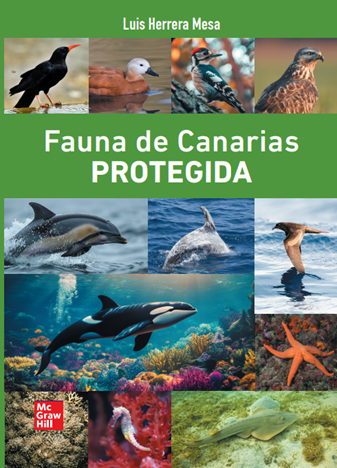
HERRERA MESA, L., 2026. Fauna de Canarias PROTEGIDA (1º Ed.). McGraw-Hill Interamericana de España S.L., xiv + 318 p. ISBN: 978-8448651503
Fauna de Canarias PROTEGIDA (Protected Fauna of the Canary Islands) by Luis Herrera-Mesa can be considered a continuation and/or culmination of another recent work of his published in 2024, entitled Fauna de Canarias en Peligro de Extinción (Endangered Fauna of the Canary Islands), which, as a prelude to this one, systematically catalogues the species of the Canary Islands that receive special protection under legal frameworks due to their biological characteristics. The current work is presented as a rigorous and accessible study of Canarian biodiversity and endangered species in the archipelago, combining scientific dissemination with a deeply conservationist perspective. Its approach integrates geology, bioclimatology, and ecology to explain why the Canary Islands are a unique and vulnerable enclave.
The work goes beyond a simple catalogue to offer a solid scientific framework before delving into the species profiles.
It is organised as a tour of the archipelago's rich fauna, focusing on endangered species and the factors that explain their ecological fragility and the need to protect them. First, it masterfully summarises the natural context of the Canary Islands (explaining the volcanic origin of the archipelago, describing the bioclimatic zones and their relationship with the distribution of species, and paying special attention to the reasons for the uniqueness of the island's fauna, marked by isolation and differentiated evolution). All this is covered in the first chapter.
The core of the book is a detailed catalogue/inventory of endangered, vulnerable, or special interest species, classified according to their level of threat. All are considered ‘special protection fauna’ (chapters 2 and 4): emblematic birds (such as the Canarian hubara, the guirre, or the Cory's shearwater), unique reptiles (such as the giant lizards of the Canary Islands, the subject of a specific study by the author, in which he compares the speciation that has occurred on the islands to that described by Darwin in the Galapagos Islands with finches), elasmobranch fishes, marine mammals, and endemic invertebrates (arthropods: insects and malacostracan crustaceans, molluscs: bivalves and gastropods, asteroidea echinoderms, polychaete annelids, anthozoa cnidarians, and demosponge porifera). All this is accompanied by succinct descriptions and illustrated with magnificent photographs that aid in their recognition.
Chapter 3 discusses the situation of species considered of special interest to the Canary Islands ecosystems. Chapter 4 includes a two-page addendum on new species in the Canary Islands that are threatened to varying degrees.
The book is completed with an appendix in which the author compiles a list of the rules, agreements, conventions, and regulations cited throughout the text, which will be a magnificent tool for managers involved in conservation.
The book ends with indexes, both onomastic and analytical, of the names and terms that appear throughout the text. All this is accompanied by an exhaustive bibliography.
In summary, the work describes the habitat, biology, geographical distribution, and various threats to 101 species and subspecies. It describes 55 species of interest to the Canary Islands ecosystems. Of these, 70 species are classified as threatened to varying degrees, and two subspecies are considered extinct. The author clearly analyses the factors that put Canarian fauna at risk: habitat loss, the introduction of invasive species, human pressure (including urban development), and the impact of climate change, resulting from global warming, on island ecosystems. He proposes science-based measures: habitat restoration, captive breeding programmes, environmental education, and outreach. He also draws attention to the importance of effective coordination between administrations and research centres.
In conclusion, this book is an essential reference for students and professionals in biology, zoology, and environmental sciences, natural space managers and conservation technicians, and any reader interested in Canarian biodiversity. Luis Herrera Mesa combines his scientific experience with a vocation for dissemination, making the book a valuable tool for understanding the richness and fragility of the Canary Islands' fauna. Protected Fauna of the Canary Islands is a solid, well-documented, and necessary work.
Its greatest merit is raising awareness of the urgency of protecting a unique natural heritage, showing that conservation is not only a technical issue but also a cultural and ethical one.